
On this page
Key points
- Masjid an-Nabawi is the mosque of the Prophet ﷺ in Madinah, the second holiest mosque in Islam after Masjid al-Haram.
- The Prophet ﷺ said one prayer in his mosque is better than a thousand prayers elsewhere, except Masjid al-Haram.
- Praying in the Rawdah needs a permit booked on the Nusuk app. Sending salam to the Prophet ﷺ does not.
- The mosque has many gates. Note the number of the gate you used and agree on one meeting gate with your family.
The story of the mosque
When the Prophet ﷺ reached Madinah on the Hijrah, one of the first things he did was build a mosque. It was a simple building of mud bricks, with palm trunks for pillars and palm leaves for the roof. The Prophet ﷺ worked on it with his own hands, next to his companions.
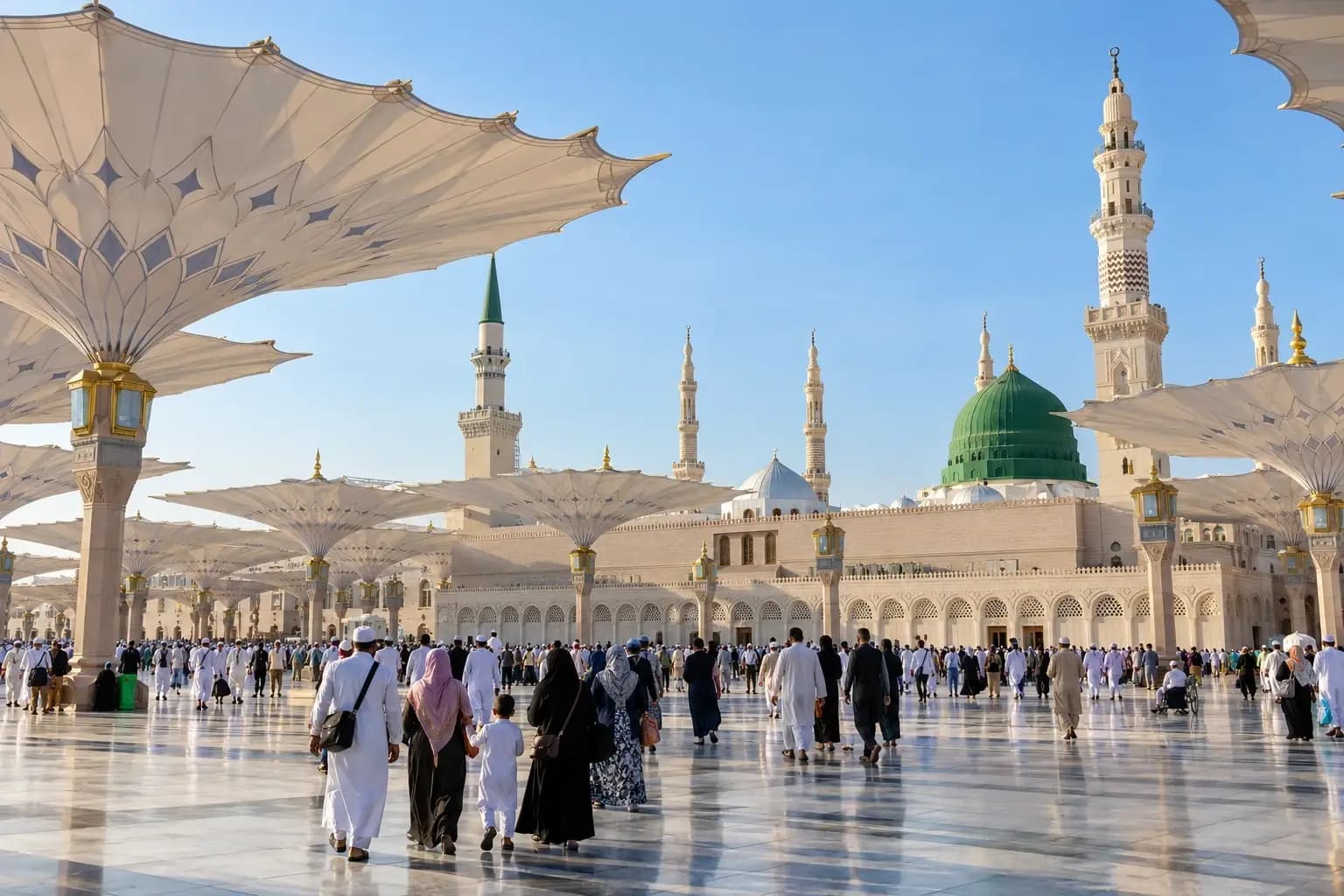
His home was beside the mosque, and he is buried there today. Over the centuries the mosque was made larger again and again. The old area is now a small part of a huge building that holds hundreds of thousands of people, with marble courtyards all around it.
Why pilgrims love to pray here
The Prophet ﷺ said that one prayer in his mosque is better than a thousand prayers in any other mosque, except Masjid al-Haram (Bukhari 1190). Many pilgrims try to pray all five prayers here during their days in Madinah.
Visiting Madinah is not part of Umrah or Hajj, and your Umrah is complete without it. But almost every pilgrim from India spends a few days here, because of the love for the Prophet ﷺ and the reward of prayer in his mosque.
The Rawdah and the green dome
The Prophet ﷺ said that the area between his house and his pulpit is a garden from the gardens of Paradise (Bukhari 1196). This small area is called the Rawdah, or Riyaz ul Jannah. It has green carpets, while the rest of the mosque has red ones.
To pray in the Rawdah you need a permit with a time slot, booked on the official Nusuk app. Men and women have separate slots, and the rules for how often you can book change from time to time. Our Rawdah guide explains the booking steps.
The green dome stands over the room where the Prophet ﷺ is buried, with Abu Bakr and Umar (RA) beside him. It is the best-known sight of Madinah and can be seen from the courtyards.
Sending salam to the Prophet ﷺ
Men usually enter by Bab as-Salam, walk slowly along the line inside the mosque, and pass in front of the grave. There, send salam calmly in a low voice, then move one step to the right for Abu Bakr (RA), and one more step for Umar (RA). The Prophet ﷺ said that whenever someone greets him, Allah returns his soul so that he returns the greeting (Abu Dawud 2041).
Keep your voice low, keep walking with the line, and do not push or stop the flow. Do not touch or kiss the walls and grills, and make your du’a to Allah facing the qiblah. Women send salam from the women’s area at the times set for them.
Salam to the Prophet ﷺ
السَّلَامُ عَلَيْكَ يَا رَسُولَ اللَّهِ وَرَحْمَةُ اللَّهِ وَبَرَكَاتُهُ
Assalamu ‘alayka ya Rasulallah, wa rahmatullahi wa barakatuh.
Peace be upon you, O Messenger of Allah, and the mercy of Allah and His blessings.
Gates, umbrellas and getting around
- Each gate has a name and a number written above it. Bab as-Salam and Bab Jibril are on the side of the old mosque; the large King Fahd gate is on the north side
- Women have their own entrances and prayer halls; follow the signs and the staff at the gates
- The giant umbrellas in the courtyards open in the morning for shade and close in the evening. They are a lovely sight at sunrise and sunset
- Shoes go in a bag or on the numbered racks; note the rack number, as many look the same
- Zamzam coolers are inside the mosque and in the courtyards
Tips for your first visit
- Go early for Fajr and Jumu’ah: the inside fills up long before the adhan
- Agree on one gate number with your family as the meeting point if anyone gets lost
- Take a small bag only. Large bags and food may be stopped at the gates
- Ask your group guide about the best time for an elderly parent; the courtyards are easier than the busy inner rows
Questions
The Prophet ﷺ said one prayer in his mosque is better than a thousand prayers in any other mosque, except Masjid al-Haram (Bukhari 1190).
Related on our site
Official guidance
This guide is general travel information. For religious rulings, please ask a qualified scholar.