
On this page
Key points
- Ihram is a state you enter with the intention and the talbiyah. Wearing the white sheets alone does not put you in ihram.
- On flights from Mumbai, pilgrims usually wear ihram before boarding and make the intention before the plane crosses the miqat.
- Men wear two unstitched white sheets and keep the head uncovered. Women wear their normal modest clothes, in any colour.
- In ihram, avoid perfume, cutting hair or nails, hunting and marital relations. Men avoid stitched clothes and head covers; women avoid niqab and gloves.
- If you make a mistake, ask a qualified scholar. A penalty may apply, depending on the case.
What ihram is
When people look up ihram rules, they often think only of the two white sheets. But ihram is really a state: a sacred condition you enter for Umrah. You enter it with the intention (niyyah) and the talbiyah, and from that moment some things are not allowed until your Umrah is complete.
The clothes are only one part. A man can wear the sheets at home and still not be in ihram, because he has not yet made the intention. And a woman is fully in ihram in her ordinary clothes once she makes the intention.
In simple words: get ready at home, make the intention at the right place, keep the rules during your Umrah, and come out of ihram when you cut your hair at the end.
Details of ihram differ between the schools of thought, such as Hanafi and Shafi’i. This is a general guide to help you prepare and to discuss with your scholar. For any personal question, follow a qualified scholar you trust.
Getting ready before ihram
Do these things before you put on ihram, ideally at home before you leave for the airport. Once you are in ihram, you cannot cut your hair or nails.
Tick items as you go; they are saved on this device.
The miqat on flights from India
The miqat is a boundary around Makkah. A pilgrim coming for Umrah should not cross it without being in ihram. Flights from Mumbai to Jeddah cross the miqat in the air, before landing, so you cannot wait until Jeddah.
That is why most pilgrims put on the ihram clothes at home or at Mumbai airport, before boarding. Changing in a small plane toilet is hard, so men usually come to the airport already dressed. Then, when the crew or the group leader announces that the miqat is near, they make the intention on the plane.
If your plan takes you to Madinah first, ask your scholar where to enter ihram. Pilgrims going from Madinah to Makkah usually enter ihram at Dhul Hulayfah, the miqat near Madinah, also called Abyar Ali.
Ask your group leader or scholar exactly when to make the intention on your flight. Do not leave it until after landing in Jeddah.
Ihram clothing for men
A man’s ihram is simple, and the same for everyone, rich or poor:
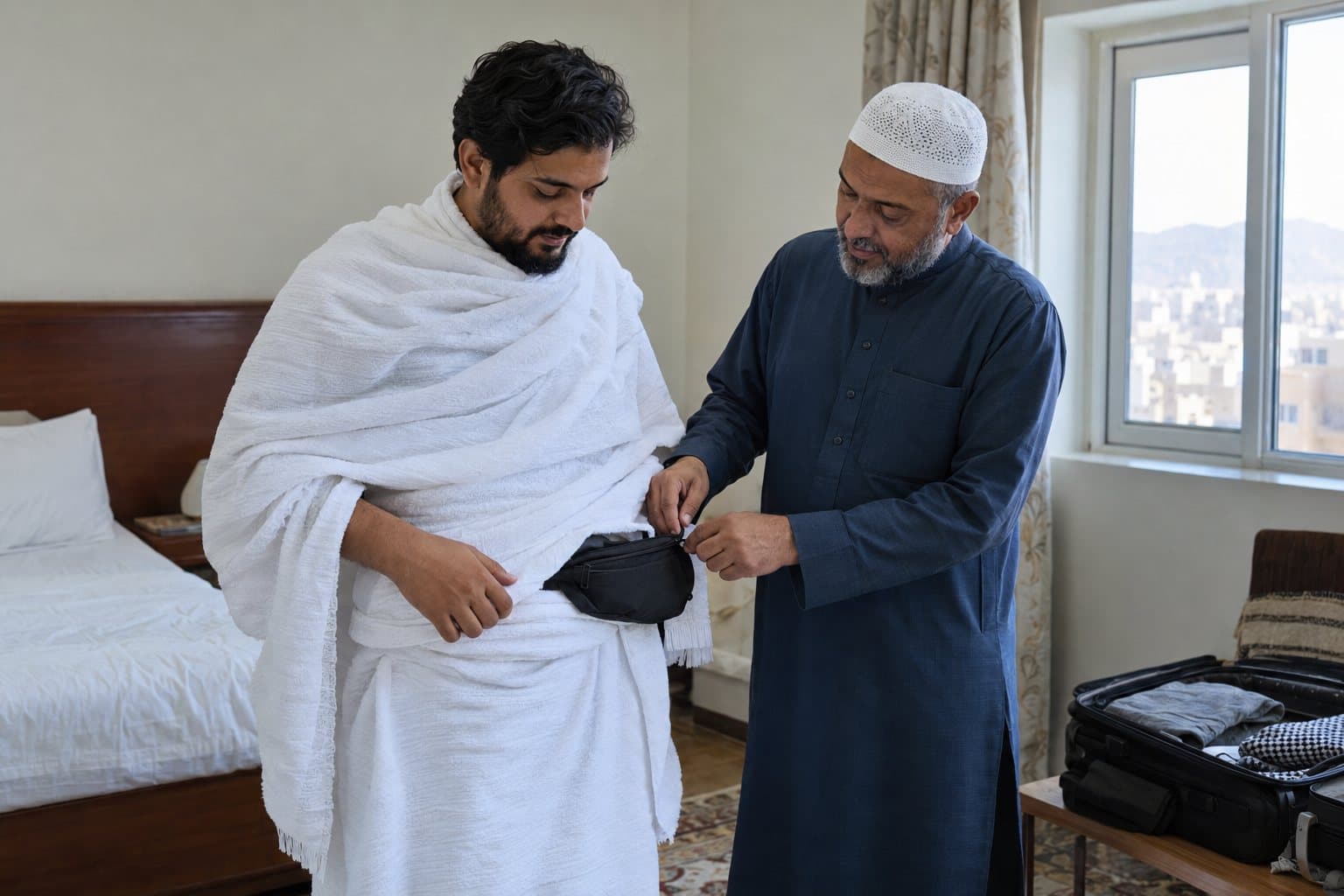
- Two plain, unstitched white sheets: one wrapped around the waist (izar) and one over the shoulders (rida)
- The head stays uncovered: no cap, topi, scarf or towel on the head
- No stitched or fitted clothes made to the shape of the body: no shirt, kurta, trousers, vest, underwear or socks
- Footwear: sandals or chappals that leave the top of the foot and the ankle bones uncovered, as commonly taught
- Allowed: a belt or pouch around the waist for money and passport
Choose thick sheets that are not see-through, and practise tying the izar at home so it stays firm while you walk.
Ihram rules for women
There is no special ihram dress for women. A woman wears her ordinary loose, modest clothes that cover the body, in any colour. White is not required. Stitched clothes, socks and closed shoes are all fine, and the hair stays covered as usual.
In ihram, most scholars teach that a woman does not cover her face with a niqab or her hands with gloves. When she wants to cover her face in front of men who are not mahram, many women let a cloth hang in front of the face without it pressing on the face, often with a cap that has a peak worn under the scarf. Your scholar can explain the method you follow.
A woman can enter ihram during her monthly period. She can make the intention and say the talbiyah, but she waits until she is pure before doing tawaf. Plan your dates with your scholar and with our team.
Niyyah and talbiyah: how ihram begins
The intention is made in the heart. Many pilgrims also say it in simple words, such as “Labbayk Allahumma ‘Umrah” (Here I am, O Allah, for Umrah).
Then say the talbiyah, and keep saying it often until you begin tawaf: men aloud, women softly. With the intention and the talbiyah, you are in ihram, and the rules below apply.
The full talbiyah, its meaning and every step of Umrah after it are in our step-by-step Umrah guide.
Ihram ki pabandiyan: what is not allowed
Once you are in ihram, these are the main things to avoid until your Umrah is complete. They are the ones most commonly taught:
- Perfume of any kind on the body, clothes or ihram, including scented soap, shampoo, cream, oil and scented wet wipes
- Cutting, shaving or plucking hair from any part of the body
- Cutting nails
- Hunting or killing wild land animals
- Marital relations, and touching or talk that leads to them
- Arguing, fighting and bad language
- For men: covering the head, and wearing stitched or fitted clothes
- For women: covering the face with a niqab, and wearing gloves
Read the labels on your toiletries before you travel. Many ordinary soaps, creams and tissues are scented.
What is allowed in ihram
Ihram is not meant to make life hard. These are generally allowed:
- Bathing and washing with unscented soap (scholars differ about soap, so follow your scholar)
- Changing into a clean ihram set, or washing your sheets. Changing the sheets does not end your ihram.
- A belt or pouch for money, passport and phone
- An umbrella, and sitting in the shade of a bus, a building or a tent
- Spectacles, a watch and your regular medicines
- For women: stitched clothes, socks and closed shoes
Made a mistake? What to do
Mistakes happen, especially on a first Umrah: a man covers his head while sleeping on the bus, someone uses a scented wet wipe, or a broken nail gets cut. Do not panic, and do not take the answer from friends or videos.
- 1
Step 1
Stop at once
Take off the cap, wash off the perfume, or stop whatever you were doing.
- 2
Step 2
Remember what happened
What was it, for how long, and was it on purpose, by mistake or out of need? The answer often depends on these details.
- 3
Step 3
Ask a scholar
Ask your group’s scholar or another qualified scholar as soon as you can, before you leave Makkah.
- 4
Step 4
Do what is needed
Depending on the case, a penalty may apply: a dam (a sacrifice) or sadaqah (charity). Your scholar will tell you what is needed and how to arrange it.
The most common serious mistake on flights is crossing the miqat without making the intention. If it happens, tell your group leader when you land and ask a scholar straight away.
When ihram ends
After tawaf, the two rak’ah and sa’i, men shave the head or trim the hair, and women cut about a fingertip’s length from the ends of their hair. This completes your Umrah, and all the ihram restrictions end. You can then change into your normal clothes.
Questions
Yes. Women wear their ordinary loose, modest clothes in any colour; white is not required. Most scholars teach that the face is not covered with a niqab and the hands are not covered with gloves.
Related on our site
Official guidance
This guide is general travel information. For religious rulings, please ask a qualified scholar.