
On this page
- 1Umrah for women: what is the same, and what is different
- 2What women wear in ihram
- 3Umrah without a mahram
- 4Rooms and travel companions
- 5Prayer areas and moving around the Haram
- 6Rawdah visit for women
- 7Periods, pregnancy and health
- 8What to pack: a short list for women
- 9Your preparation, step by step
- 10Questions
Key points
- Women perform the same rites as men, with a few small differences, such as clothing, saying the talbiyah softly and walking at a normal pace in sa’i.
- There is no special ihram dress for women: wear your normal loose, modest clothes. Most scholars say the face and hands stay uncovered in ihram.
- As reported, Saudi visa rules allow women aged 18 and above to come for Umrah without a mahram in an organised group. The religious ruling is a separate question for your scholar.
- Rawdah visits in Madinah are booked in the Nusuk app, with separate timings for women and men.
- Write down personal questions, such as periods during the trip, and ask a qualified scholar before you travel.
Umrah for women: what is the same, and what is different
Umrah for women is the same act of worship as for men: ihram with the intention, tawaf, sa’i and cutting the hair. Many women perform it with their husbands, their children, their parents or a group from their town.
A few things are different for women. This guide covers the practical side: what to wear, travelling without a mahram, rooms, prayer areas, the Rawdah and packing. The main differences, in short:
- No special ihram dress: normal, modest clothes in any plain colour
- The talbiyah is said softly, not aloud
- In sa’i, women walk at a normal pace, including between the green lights
- Men uncover the right shoulder in tawaf; women stay fully covered
- At the end, women cut about a fingertip’s length from the ends of their hair, in private
Rulings on some details differ between schools of thought. Learn the rites from a qualified scholar before you travel, and follow the scholar you trust.
What women wear in ihram
Women do not have a special ihram dress. You wear your normal loose, modest clothes that cover the body. Many women choose an abaya or a long dress with a scarf. White is common, but any plain colour is fine.
Women may wear stitched clothes, socks and normal shoes. The unstitched sheets and the uncovered head are for men only.
Most scholars say that in ihram a woman keeps her face and hands uncovered, so no niqab and no gloves. Women who normally cover their face often ask how to keep purdah in front of men during ihram. Ask your scholar what is allowed in your school of thought.
From the intention until the Umrah is finished, avoid perfume, attar and scented creams or wipes, the same as men. Buy unscented soap and shampoo before you leave.
Umrah without a mahram
Many women ask whether they can do Umrah without a mahram. The answer has two separate parts: what the Saudi visa rules allow, and what the religious ruling is for you.
The visa side: as reported (October 2026), Saudi visa rules allow women aged 18 and above to come for Umrah without a mahram when they travel with an organised group.
The religious side: the ruling differs between schools of thought. Many Hanafi scholars, whose fiqh many families in India follow, say a woman needs a mahram for a long journey such as Umrah. Other scholars allow it in some situations. Please ask a qualified scholar you trust before you book.
If you plan to travel without a mahram, tell us at the start, so the room and your travel companions can be planned before you pay.
Visa rules are set by Saudi Arabia and can change at short notice; we tell you the current position when you apply. The religious ruling is a question for your scholar.
Rooms and travel companions
Our group packages are priced on 5-bed average sharing, which means about five people share a room. Quad, triple and double rooms are available at a different price.
Tell us who you are travelling with: your husband, your mother, your sisters or other women from your town. Our team confirms the room arrangement with you before travel.
Tick items as you go; they are saved on this device.
Prayer areas and moving around the Haram
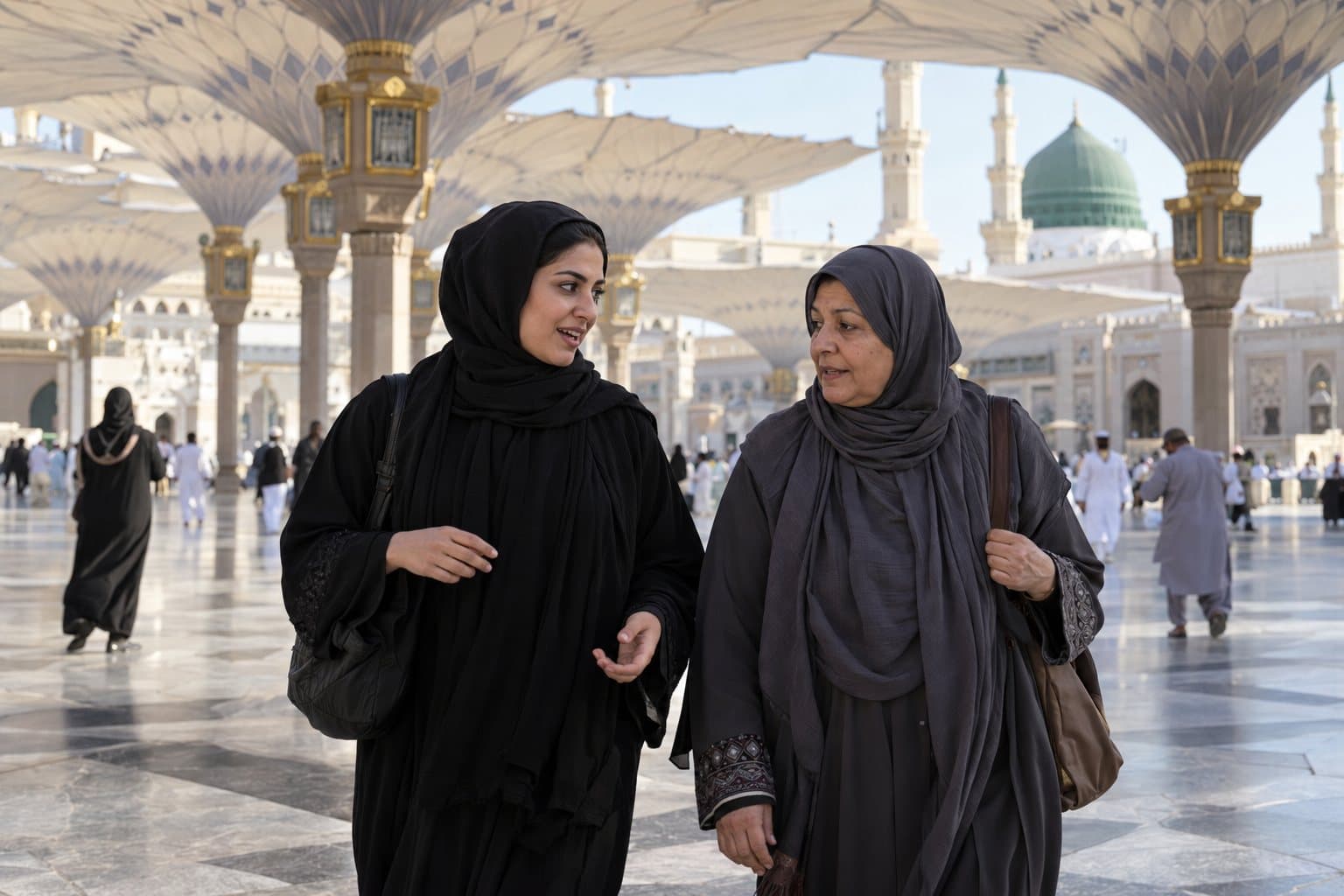
Both Harams have prayer areas for women. In Masjid an-Nabawi in Madinah, women use separate gates and sections, so a husband and wife, or a son and his mother, go in through different doors.
In Masjid al-Haram in Makkah, women pray in the women’s areas, while tawaf and sa’i are done by men and women together. It can be very crowded near the Kaaba.
- Agree on a meeting point outside a numbered gate before you separate
- Do tawaf at calmer times, such as soon after Fajr, or on the upper floors
- Avoid the crush near the Black Stone; you can raise your hand towards it from a distance
- Keep your shoes in a bag, so you can leave by any gate
- Stay with another woman from your group, especially late at night
- Carry the hotel card, in case your phone battery runs out
Rawdah visit for women
The Rawdah is the area in Masjid an-Nabawi between the Prophet’s ﷺ minbar and his house. As reported, a visit needs a slot booked in the Nusuk app, and the official guidance gives separate timings for women and men.
On the day, reach early, keep your booking open on your phone, and follow the staff’s directions to the women’s entry. Slots depend on what is free in Nusuk, so no one can promise a particular time.
Set up your Nusuk account on the phone you will carry before you leave India. Ask our team if you need help with the app.
Periods, pregnancy and health
Many women worry about their period starting before or during the Umrah. Ask a qualified scholar before you travel what to do in your situation, and tell our team privately, so the plan can allow for it.
A longer stay gives more room if your dates are uncertain. The 20-day package has five more nights in Makkah than the 15-day package.
Some women ask their doctor about tablets to delay a period during travel. That is a medical decision for your doctor; the religious side is a question for your scholar.
If you are pregnant, speak to your doctor and check the airline’s rules before booking. Airlines have their own limits for travel in later pregnancy.
What to pack: a short list for women
Our full Umrah packing list has more detail. These are the things women most often need, or forget.
Tick items as you go; they are saved on this device.
Your preparation, step by step
A calm trip starts at home. Most of the work is done in the weeks before you leave.
- 1
Step 1
Talk to your family
Decide who you will travel with, and whether a mahram can come. If not, tell us at the start.
- 2
Step 2
Take your questions to a scholar
Write them down: travelling without a mahram, ihram and face covering, periods during the trip, and anything about your own situation.
- 3
Step 3
See your doctor
For a check-up, your regular medicines, and any questions about periods or pregnancy.
- 4
Step 4
Learn the rites
Learn the steps of Umrah before you go, so you can follow them calmly with the group.
- 5
Step 5
Set up your phone
Install the Nusuk app, save our team’s numbers, and share your travel details with family at home.
Questions
As reported (October 2026), Saudi visa rules allow women aged 18 and above to come for Umrah without a mahram in an organised group. The religious ruling differs between schools of thought, and many Hanafi scholars require a mahram for a long journey. Please ask a qualified scholar before you book.
Related on our site
Official guidance
This guide is general travel information. For religious rulings, please ask a qualified scholar.