
On this page
Key points
- A few hundred metres south-west of Masjid an-Nabawi is the area of the old Musalla, the open ground where the Prophet ﷺ prayed the Eid prayers.
- Masjid al-Ghamama stands there, with Masjid Abu Bakr, Masjid Umar and Masjid Ali close by, linked by tradition to the Eid prayers of the Prophet ﷺ and the caliphs.
- Masjid al-Jumu’ah, on the road between Quba and Madinah, is linked to the first Friday prayer the Prophet ﷺ led on the Hijrah.
- Some of these mosques are opened only at certain times or kept closed, and this changes. There is no special prayer or reward reported for visiting them.
The old Eid prayer ground
The Prophet ﷺ did not pray the Eid prayers inside his mosque. He went out to an open ground called the Musalla (Bukhari 956), and he also prayed the prayer for rain there (Bukhari 1012).
Over the centuries small mosques were built in this area, close to each other. Today they sit a short walk from the south-west corner of the Masjid an-Nabawi courtyard, among the hotels, and are easy to see on a morning walk.
Masjid al-Ghamama
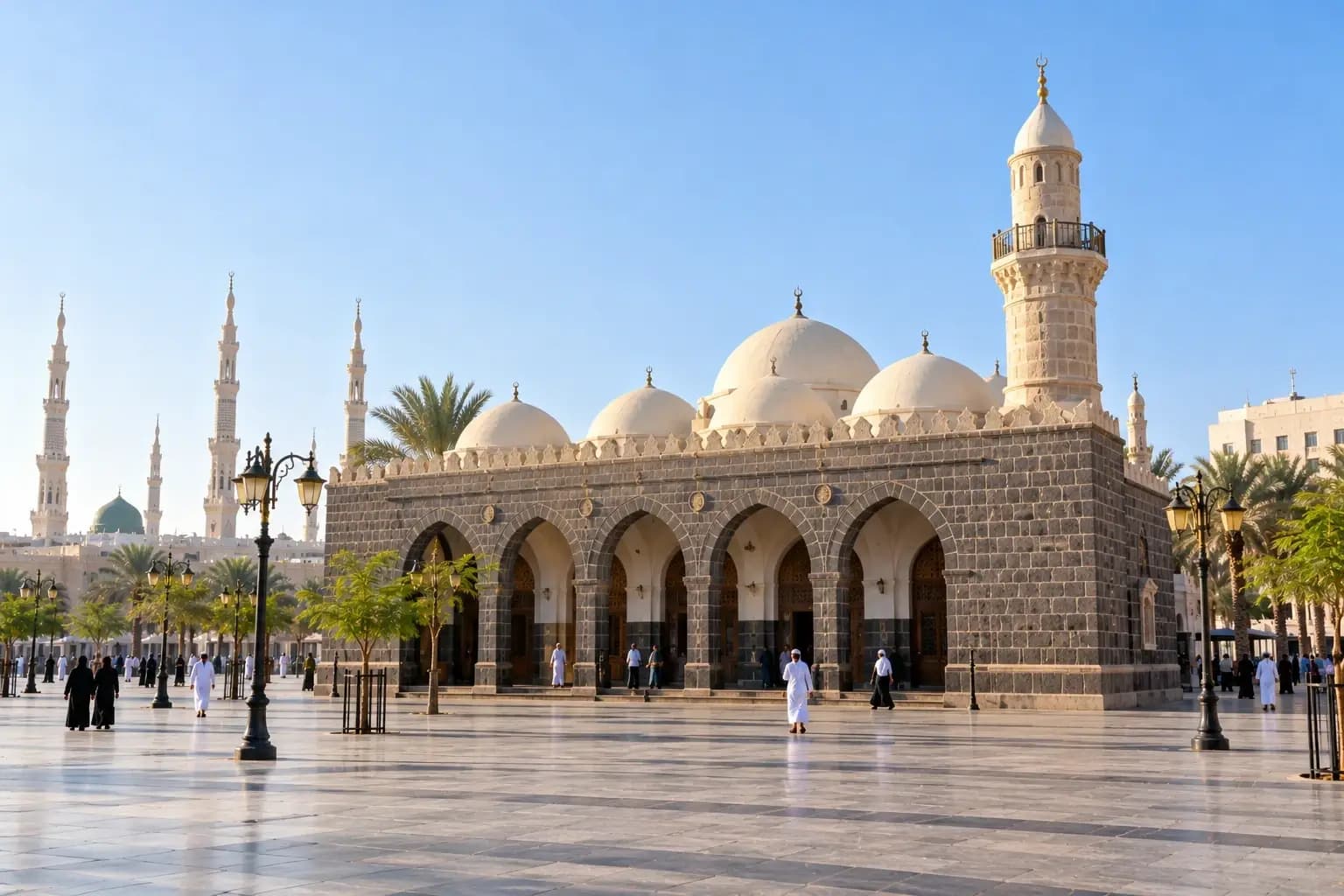
Ghamama means cloud. By tradition, the mosque stands where the Prophet ﷺ prayed the Eid prayers in his later years, and where he prayed for rain, after which clouds came. Some reports also link it to the funeral prayer in absence that he prayed for the Negus, the king of Abyssinia.
The building you see today, with its grey stone and several small domes, dates from the Ottoman period and has been restored since. It is the best-known of the small mosques and is often included in Madinah ziyarat walks.
Masjid Abu Bakr, Masjid Umar and Masjid Ali
- Masjid Abu Bakr: a small domed mosque just north of Masjid al-Ghamama. Tradition says Abu Bakr (RA) prayed the Eid prayer here during his caliphate. It is among the most-searched of these mosques
- Masjid Umar: a little to the south-west of Ghamama, linked by tradition to the Eid prayer of Umar (RA) during his caliphate
- Masjid Ali: nearby, linked by tradition to Ali (RA) praying the Eid prayer in this area
These links come from local history and tradition, not from sahih hadith. Their value is as reminders of the first generations; there is no special prayer for any of them.
Masjid al-Jumu’ah
On the Hijrah, after his days in Quba, the Prophet ﷺ set out for the centre of Madinah on a Friday. On the way, in the valley of the tribe of Banu Salim ibn Awf, the time of Jumu’ah came, and according to the books of seerah he led the Friday prayer there with a khutbah. It is remembered as the first Jumu’ah he led.
A mosque stands at that place today, called Masjid al-Jumu’ah. It is a working mosque, between Masjid Quba and Masjid an-Nabawi, and some ziyarat tours pass it on the way back from Quba.
Visiting the small mosques
- Walk from the south-west side of Masjid an-Nabawi in the cool of the morning; the four Musalla mosques are within a few minutes of each other
- Some may be closed or opened only for certain prayers. Look from outside if the doors are shut; the rules change from time to time
- Pray two rak’ahs in a mosque that is open, if it is not a time when prayer is disliked
- Keep to the sunnah: no touching walls for blessing, no special rituals, and no extra reward claimed for these visits
Questions
Just north of Masjid al-Ghamama, a short walk from the south-west corner of Masjid an-Nabawi. Tradition links it to Abu Bakr (RA) praying the Eid prayer there during his caliphate.
Related on our site
Official guidance
This guide is general travel information. For religious rulings, please ask a qualified scholar.