
On this page
Key points
- The Kiswah is the black silk cover of the Kaaba, embroidered with Qur’an verses in gold and silver thread.
- It is made by hand and machine at a special complex in Makkah, and a new one is put on every year. In recent years the change has been on 1 Muharram, the start of the Islamic year.
- Before Hajj the lower part is lifted and covered with white cloth, to protect it in the crowds.
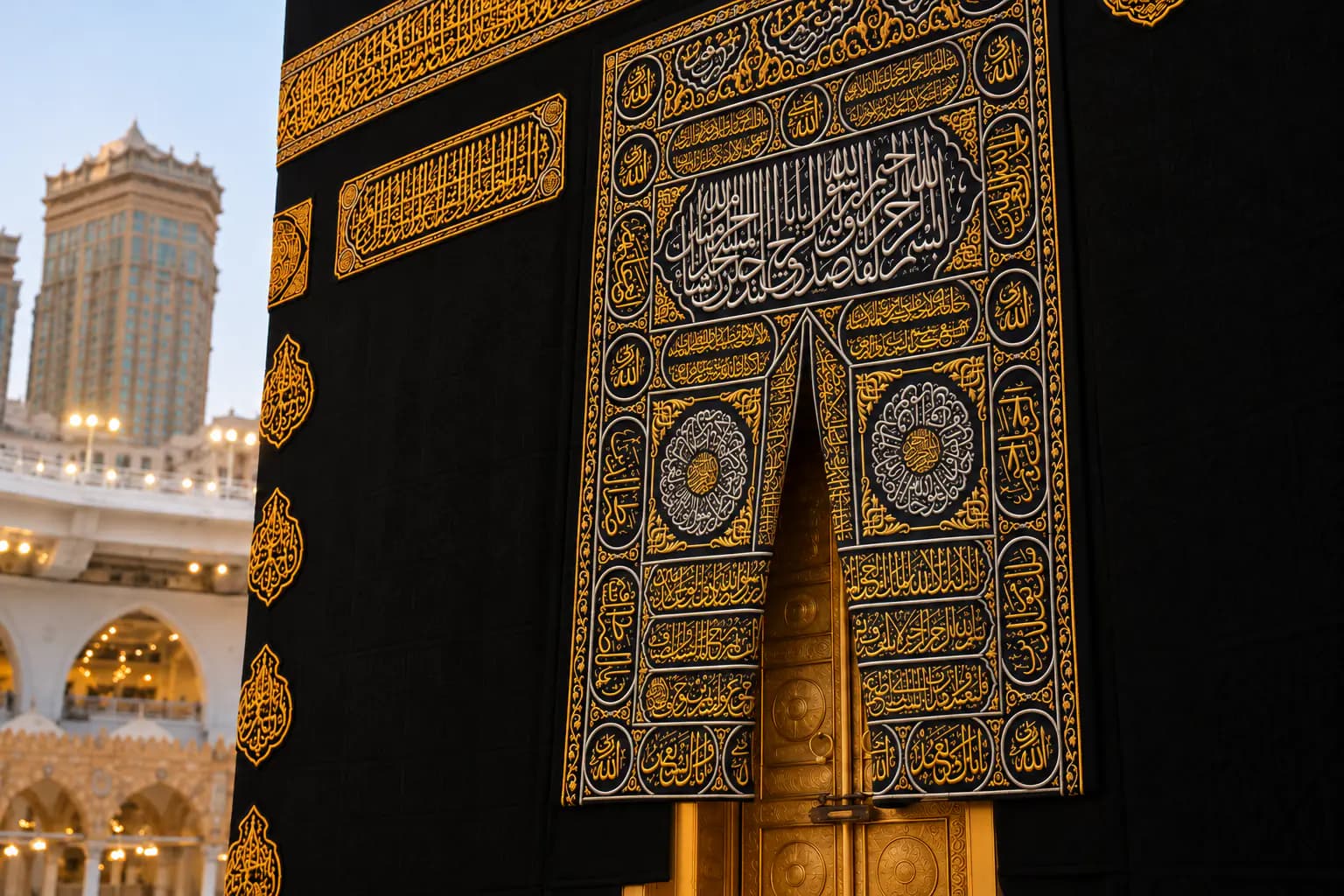
- The door of the Kaaba, on the eastern wall, is covered in gold and opened only on official occasions.
What the Kiswah is
Kiswah means “covering”. It is the cloth that dresses the Kaaba on all four sides. Honouring the House this way is part of respecting the symbols of Allah, which the Qur’an links to taqwa of the heart (22:32).
The Kaaba has been covered since long before Islam, in different cloths and colours. For many centuries now the cover has been black, and in modern times it has been made in Makkah itself.
How it is made
- Fabric: natural silk, dyed black, woven with patterns of Qur’anic phrases that you see only up close
- Embroidery: a wide band around the upper third, with verses of the Qur’an stitched in gold- and silver-plated thread
- Size: it is made in many separate pieces that are joined on the Kaaba, as each wall is over ten metres tall
- Weight: hundreds of kilograms of silk and a large amount of gold and silver thread go into each Kiswah
- Place: the King Abdulaziz Complex for the Kiswah of the Holy Kaaba in Makkah, where skilled workers weave, print and embroider it over months
Figures for weight and cost differ between reports and change from year to year, so treat them as rough.
The yearly change
Every year the old Kiswah is taken down and the new one is raised, piece by piece, by a team from the complex. For many years this was done on the Day of Arafah, while the pilgrims were away at Arafat. In recent years the change has been moved to the night of 1 Muharram, the start of the Islamic year.
The old Kiswah is cut into pieces. Some are kept, some are given as official gifts. If anyone sells you a “piece of the real Kiswah”, be careful: most such pieces are copies.
Why the hem is lifted in the Hajj season
Before Hajj the lower part of the Kiswah is rolled up about three metres and the bare wall is wrapped in a band of white cotton. This protects the silk from being pulled, cut or touched by the huge crowds. People sometimes call it the “ihram of the Kaaba”, though it is only a practical measure.
After the season the hem is let down again. So if your Umrah is in the busy months, you may see the white band; on a quieter visit you will see the black silk reach the marble.
The door of the Kaaba
The door, Bab al-Kaaba, is on the eastern wall, between the Black Stone corner and the Hijr Ismail, about two metres above the ground. The present door, made in modern times, is covered in gold with verses and the names of Allah.
Over the door hangs a separate embroidered curtain, the richest part of the Kiswah, with gold calligraphy from the Qur’an. The door is opened only for the yearly washing and for official guests, when wheeled steps are brought to it.
The wall between the door and the Black Stone is the Multazam, where many pilgrims make du’a when there is space.
Questions
It is the black silk cover of the Kaaba, embroidered with verses of the Qur’an in gold and silver thread. A new one is put on every year.
Related on our site
Official guidance
This guide is general travel information. For religious rulings, please ask a qualified scholar.