
On this page
Key points
- The Kaaba is the House of Allah in Makkah, the qiblah that Muslims face in every prayer.
- The Qur’an tells that Ibrahim (AS) and his son Ismail (AS) raised its foundations.
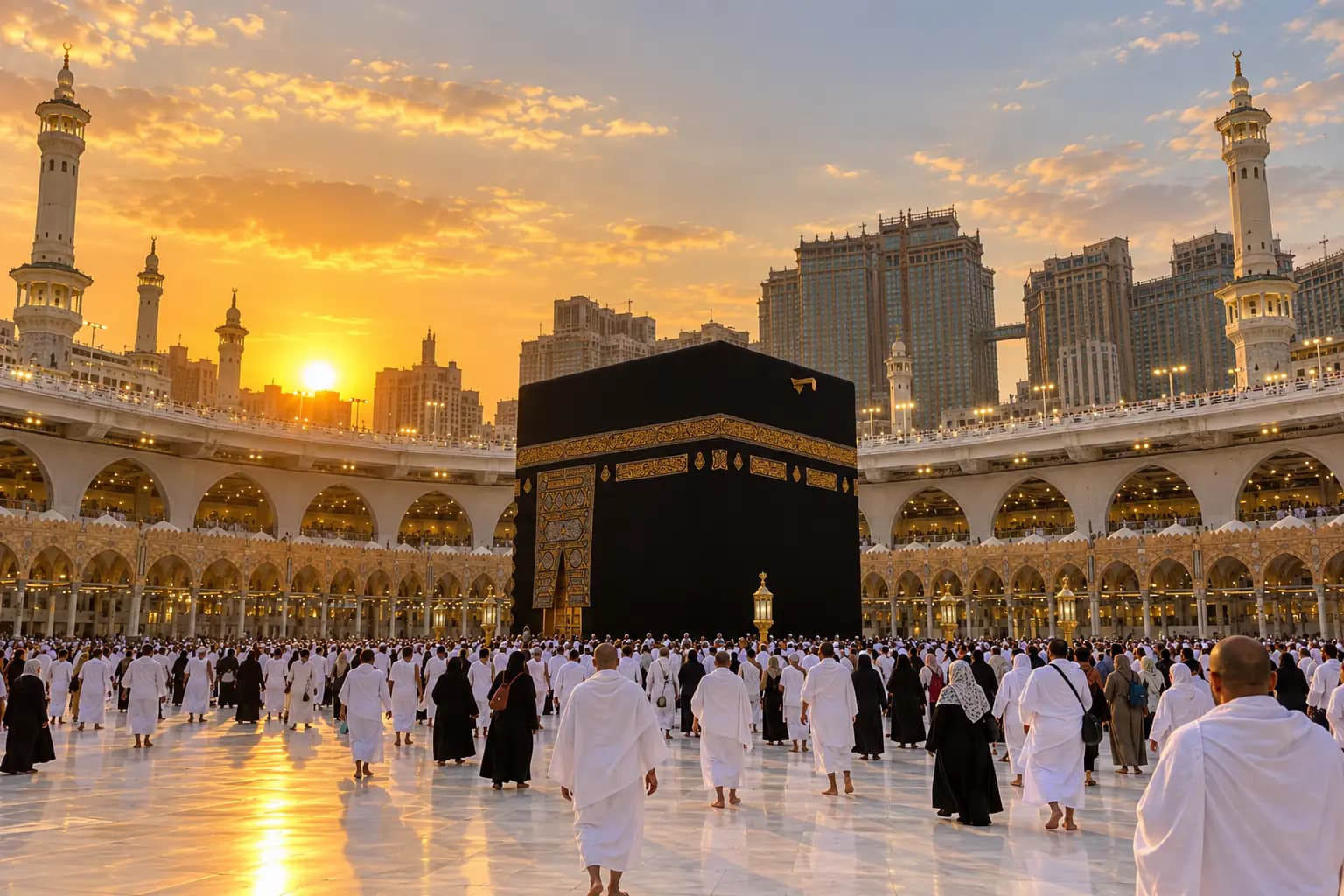
- It stands about 13 metres high, with a door on the east side and four corners; the Black Stone is set in the eastern corner, where tawaf begins.
- It is covered by the Kiswah, a black silk cloth with gold calligraphy, which is changed once a year.
What the Kaaba is
The Kaaba is the cube-shaped building in the centre of Masjid al-Haram in Makkah. Muslims all over the world face it when they pray, and pilgrims walk around it in tawaf. It is not worshipped; it is the House that Allah chose as the direction of worship.
The Qur’an calls it the first House set up for people, at Bakkah (an old name of Makkah), a blessing and guidance for the worlds (3:96).
Who built the Kaaba
The Qur’an describes Ibrahim (AS) and Ismail (AS) raising the foundations of the House and praying, “Our Lord, accept this from us” (2:127). Over the centuries the building was repaired and rebuilt several times after floods and damage.
One rebuilding happened when the Prophet ﷺ was about 35 years old, before his prophethood. When the tribes argued over who would set the Black Stone back in its place, he placed it on a cloth, had each tribe’s leader lift a corner, and set it in place himself, ending the dispute peacefully.
In that rebuilding the Quraysh did not have enough lawful money to finish the full original size, so they left out part of it. That part is the low curved wall beside the Kaaba, the Hijr Ismail (also called the Hateem), which is why tawaf goes around the outside of it.
The parts of the Kaaba
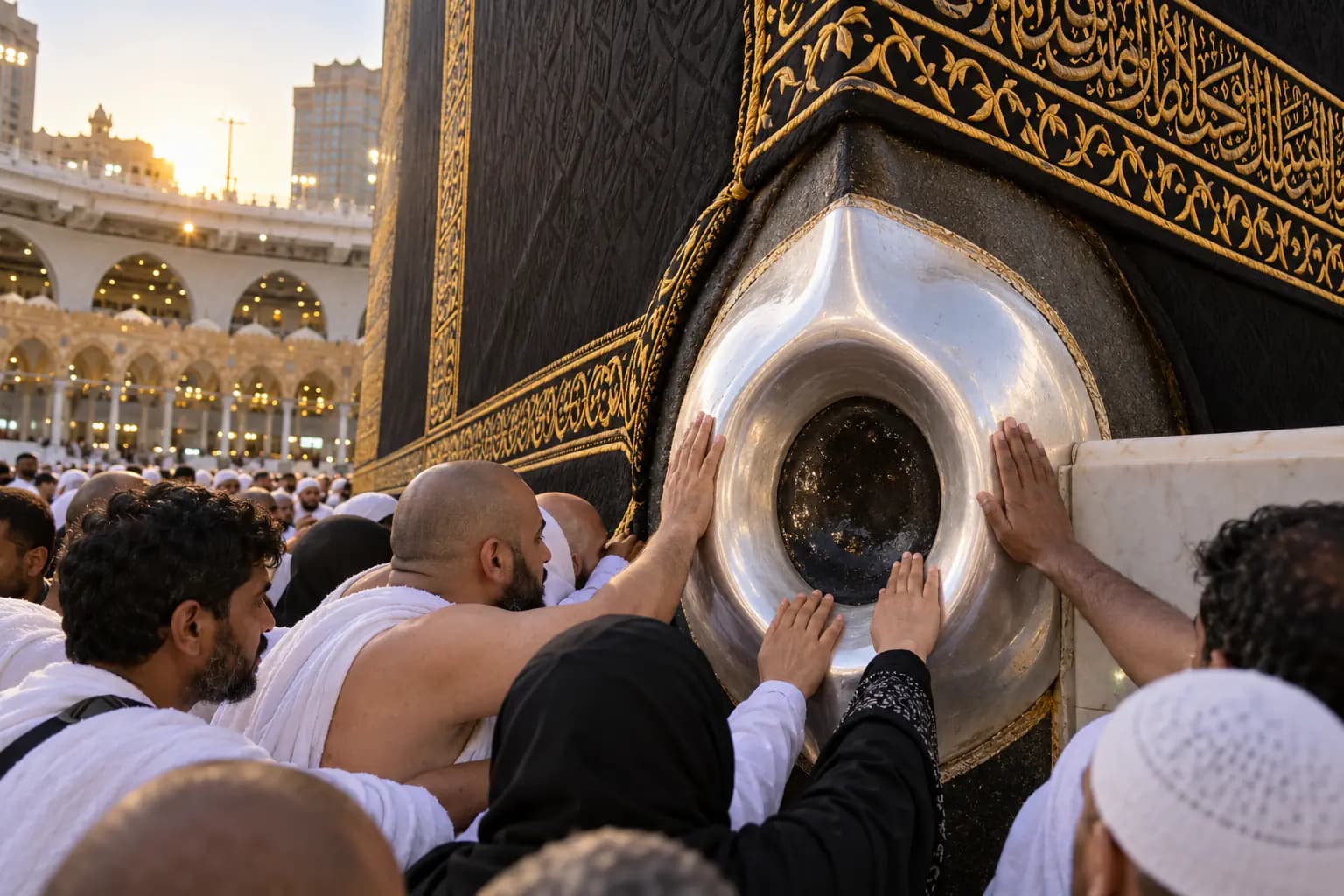
- The Black Stone (Hajar al-Aswad): set in a silver frame in the eastern corner; every round of tawaf begins and ends here
- The Yemeni corner (Rukn al-Yamani): the corner before the Black Stone; pilgrims touch it if they can, without kissing it
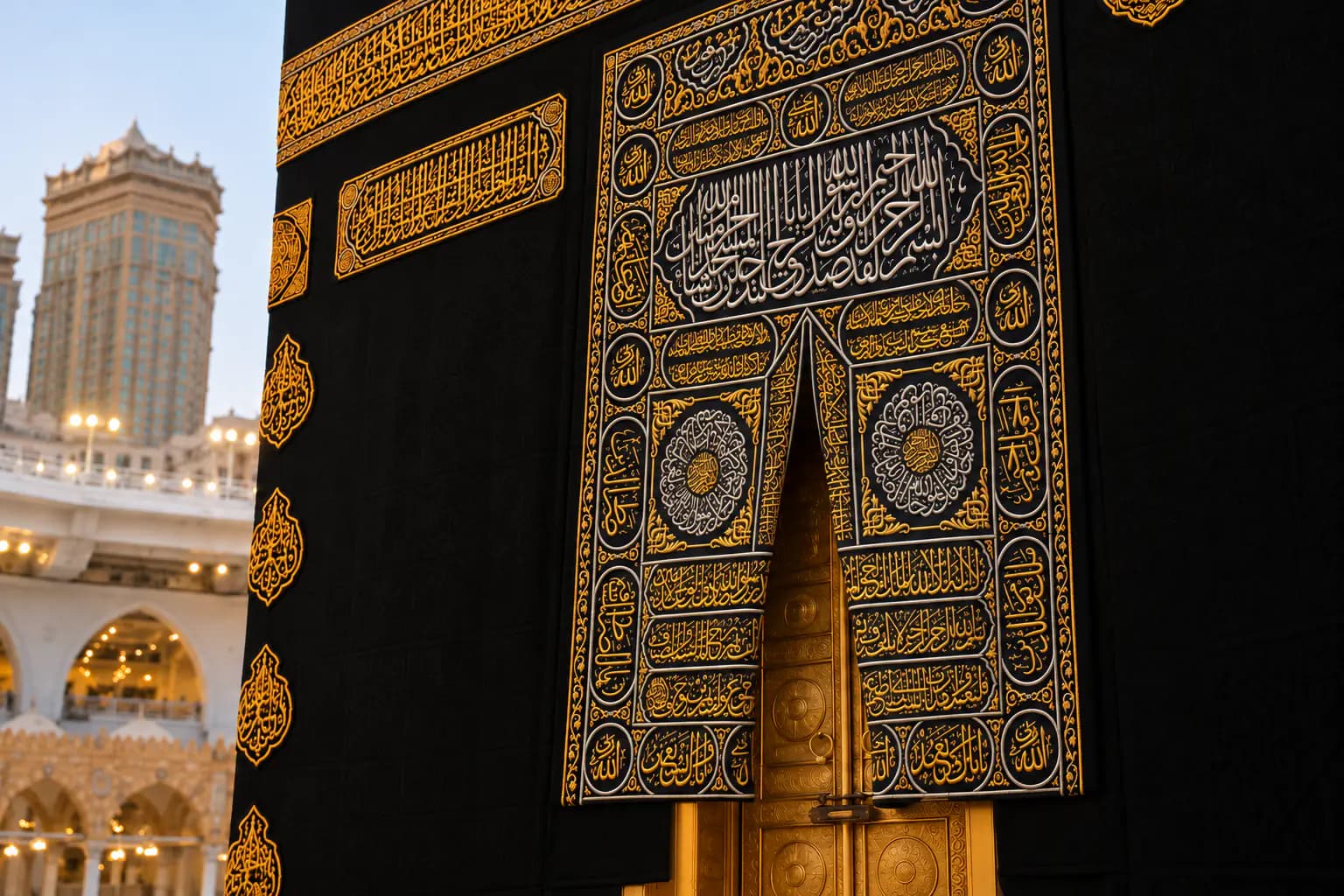
- The door (Bab al-Kaaba): on the eastern wall, about two metres above the ground, covered in gold
- The Multazam: the wall between the door and the Black Stone, where many pilgrims make du’a when there is space
- The Mizab: the golden rain spout on the roof, over the Hijr Ismail
- Maqam Ibrahim: the stone kept in a gold and glass case near the Kaaba, linked to Ibrahim (AS) building the House
 Illustrative image
The Kiswah
The black cloth on the Kaaba is called the Kiswah. It is made of silk, dyed black, with verses of the Qur’an woven in gold and silver thread on a band around the upper part and on the curtain of the door.
It is made in Makkah at a special complex and replaced with a new one once a year. In recent years the new Kiswah has been put on at the start of the Islamic new year. During the busy season the lower part is often lifted and wrapped in white cloth to protect it.
 Illustrative image
What is inside the Kaaba
The Kaaba is a room, not a solid block. Inside there are pillars holding up the roof, marble walls and lamps hanging from the ceiling. There is nothing in it to be worshipped.
It is not open to visitors. The inside is washed once a year in a small ceremony led by the authorities. Pilgrims are not able to enter, so if anyone offers to “take you inside the Kaaba”, do not believe it.
Before your first tawaf
- The first sight of the Kaaba is a moment for du’a. Take a few seconds, raise your hands and ask Allah for what is in your heart
- Find the Black Stone line (a green light on the wall of the mosque) before you start, so you begin tawaf at the right place
- Keep the Kaaba on your left and do not push towards it; touching the Black Stone is not required, and raising your hand from a distance is enough
- Agree on a meeting point with your family, such as a numbered gate, before you join the crowd
Questions
The Qur’an tells that Ibrahim (AS) and his son Ismail (AS) raised its foundations. It has been repaired and rebuilt several times since, including once by the Quraysh when the Prophet ﷺ was about 35.
Related on our site
Official guidance
This guide is general travel information. For religious rulings, please ask a qualified scholar.