
On this page
Key points
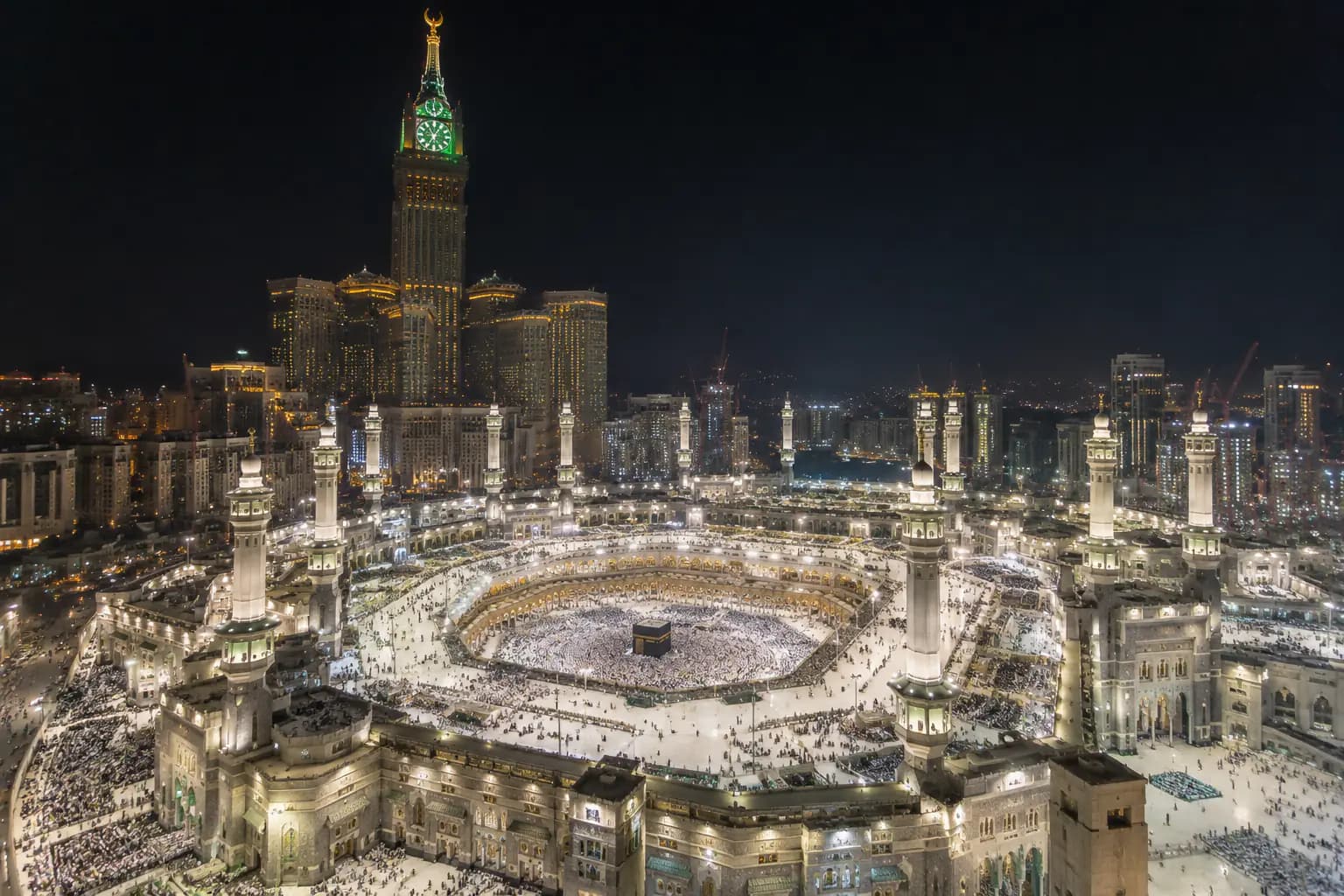
- Masjid al-Haram is the mosque around the Kaaba, the largest mosque in the world, with several floors and hundreds of doors.
- The open courtyard around the Kaaba is the mataf, where tawaf is done. The Mas’a, the long hall for sa’i, runs along one side of the mosque.
- Every gate has a name and a number on a sign. Note the gate you came in by and agree on a meeting point with your family.
- The Prophet ﷺ said one prayer here is better than a hundred thousand prayers elsewhere.
Why Masjid al-Haram is special
Masjid al-Haram, the Sacred Mosque, surrounds the Kaaba, the first House set up for the worship of Allah (3:96). It is the qiblah of every Muslim’s prayer (2:144) and one of the only three mosques that the Prophet ﷺ encouraged people to travel to (Bukhari 1189).
The Prophet ﷺ said that one prayer in Masjid al-Haram is better than a hundred thousand prayers elsewhere (Ibn Majah 1406). So even on rest days of your Umrah, try to pray the five prayers here.
The layout in simple words
- The mataf: the open marble courtyard around the Kaaba, where tawaf is done. Upper levels around it also allow tawaf, with a longer round
- The old Ottoman building: the inner arcade of domes and arches around the mataf
- The Saudi expansions: the large halls beyond it, built in stages, including the King Fahd expansion and the newer King Abdullah expansion to the north
- The Mas’a: the long, wide hall between the hills of Safa and Marwah, used for sa’i, on several floors
- The roof and the outer courtyards: used for prayer when the inside is full, with Zamzam coolers and shade at many points
Gates and finding your way
- The mosque has many gates. Each one has a name and a number, shown in Arabic and English above it
- Major gates such as the King Abdulaziz Gate, the King Fahd Gate and the King Abdullah Gate are easy landmarks
- Note the gate number you enter by, and agree on one meeting point with your family, such as a gate or a clock tower entrance
- Some gates are kept for men or women only at prayer time, or are closed when an area is full. Follow the guards’ directions
- Keep your hotel card with you, and save the location on your phone
Prayer times and crowds
The mosque fills up well before each prayer, especially Fajr, Maghrib and Jumu’ah. Go 30 to 60 minutes early if you want to pray inside or near the mataf. Once areas are full, the staff close them and guide people to the roof or outer courtyards.
The calmest time for tawaf is usually mid-morning after Ishraq, or late at night. Friday and the last ten nights of Ramadan are the busiest of all.
Practical things
- Shoes: carry them in a small cloth bag; shoe racks fill up and it is easy to lose a pair
- Bags: keep to a small bag. Large bags, food and bulky items may be stopped at the gate
- Zamzam: free in coolers all over the mosque, cold and not cold, with cups beside them
- Women: there are separate prayer areas for women on each floor, marked by signs and female staff
- Wheelchairs and carts: available at the mosque, and there are routes for them on the upper floors. Ask at the service counters
- Lost and found, and lost people: ask any staff member for the nearest help point; children should carry a card with a parent’s phone number
- Washrooms and wudu areas: outside the mosque, under the courtyards, signed in many languages
Respect in the mosque
- Keep your voice low and your phone on silent; avoid photos that disturb people in prayer
- Do not sit or pray in the path of people doing tawaf
- Do not reserve large spaces with mats or bags
- Help elderly pilgrims, and be patient when the crowd slows down
Questions
The Sacred Mosque in Makkah that surrounds the Kaaba. It is the qiblah of Muslims and the largest mosque in the world.
Related on our site
Official guidance
This guide is general travel information. For religious rulings, please ask a qualified scholar.