
On this page
- 1Ziyarat places in Makkah and Madinah at a glance
- 2Jabal al-Nour and the Cave of Hira
- 3Jabal Thawr: the cave of the Hijrah
- 4Arafat, Muzdalifah and Mina: the places of Hajj
- 5Masjid Aisha at Tan’eem
- 6Masjid Quba and Masjid al-Qiblatain
- 7Mount Uhud and the martyrs of Uhud
- 8Jannat al-Baqi, the Seven Mosques and the date farms
- 9Coach stop, short walk or climb? Planning the day
- 10Good manners at the places you visit
- 11Questions
Key points
- In Makkah, groups usually see Jabal al-Nour, Jabal Thawr, Arafat, Muzdalifah and Mina in one morning, mostly from the coach.
- In Madinah, the usual stops are Masjid Quba, Masjid al-Qiblatain, Mount Uhud and Jannat al-Baqi.
- Most places need only a short walk. Climbing to the Cave of Hira or up Jabal Thawr is a steep, separate climb for fit adults.
- Go in the morning, carry water, and let elders stay seated where a stop involves a climb or a long walk.
- Ziyarat is not part of the rites of Umrah. For religious questions about any place, ask a qualified scholar.
Ziyarat places in Makkah and Madinah at a glance
Ziyarat means visiting the places linked to the life of the Prophet ﷺ and the early Muslims. It is not part of the rites of Umrah, but it brings the seerah to life: you see the mountain where the first revelation came, the cave where the Prophet ﷺ hid during the Hijrah, and the field where the martyrs of Uhud rest. This guide covers the ziyarat places in Makkah and Madinah that pilgrims from India visit most, with a little history and practical tips for each.
- Makkah: Jabal al-Nour (the Cave of Hira), Jabal Thawr, Arafat and Jabal al-Rahmah, Muzdalifah, Mina, and Masjid Aisha at Tan’eem
- Madinah: Masjid Quba, Masjid al-Qiblatain, Mount Uhud and the martyrs’ graveyard, Jannat al-Baqi, the Seven Mosques near the site of the Trench, and the date farms
Our current itinerary plan includes a guided morning ziyarat in Makkah (Jabal al-Nour, Jabal Thawr, Mina, Arafat and Muzdalifah, back in time for Dhuhr) and a guided ziyarat in Madinah (Masjid Quba, Masjid al-Qiblatain, Mount Uhud and Jannat al-Baqi). The exact places and days are confirmed for your departure week.
Jabal al-Nour and the Cave of Hira
Jabal al-Nour, the Mountain of Light, stands a few kilometres north-east of Masjid al-Haram. Near its top is the Cave of Hira, where the Prophet ﷺ used to spend days alone in worship before prophethood. It was here that the angel Jibreel brought the first verses of the Qur’an, beginning with “Iqra” (Read).
The path up is steep, with many steps, and can take an hour or more to climb. Group visits usually stop at the foot of the mountain. If a fit adult wants to climb, go early in the morning with water; it is not suitable for elders or anyone with heart or knee problems.
Jabal Thawr: the cave of the Hijrah
Jabal Thawr lies to the south of Makkah. When the Prophet ﷺ left Makkah for Madinah, he and Abu Bakr (RA) hid in a cave near its top for three nights while the Quraysh searched for them. The Qur’an mentions this moment in Surah at-Tawbah (9:40).
The mountain is higher and the climb longer than Jabal al-Nour, so groups usually see it from the coach or from a short stop nearby.
Arafat, Muzdalifah and Mina: the places of Hajj
On the Makkah ziyarat, the coach usually drives through the three places where the main days of Hajj are spent. Outside Hajj they are quiet, which makes it easier to take them in.
Arafat is a wide plain about 20 km east of Makkah. Standing here on the 9th of Dhul Hijjah is the heart of Hajj, and the Prophet ﷺ gave his Farewell Sermon at Arafat during his Hajj. Jabal al-Rahmah, the Mount of Mercy, is a small hill on the plain where many visitors stop; climbing it is not part of Umrah or Hajj.
Muzdalifah lies between Arafat and Mina. Hajj pilgrims spend the night here under the open sky after the Day of Arafah, and many collect their pebbles for the stoning here.
Mina is the valley of white tents a few kilometres from the Haram, where pilgrims stay during the days of Hajj. The Jamarat, the three pillars that pilgrims stone, are in Mina, and so is Masjid al-Khayf.
Masjid Aisha at Tan’eem
Masjid Aisha stands at Tan’eem, just outside the boundary of the Haram, to the north of Makkah. It is named after Aisha (RA): during the Farewell Hajj, the Prophet ﷺ sent her with her brother Abdur-Rahman (RA) to Tan’eem to enter ihram for an Umrah.
Today, pilgrims staying in Makkah who wish to perform another Umrah often go here to put on ihram, as it is a short drive from the Haram. Our itinerary plan includes an optional second Umrah with ihram from Masjid Aisha, with our team’s help. Whether to repeat Umrah, and how often, is a question for your scholar.
Masjid Quba and Masjid al-Qiblatain
Masjid Quba is the first mosque built in Islam. The Prophet ﷺ laid its foundation when he reached Quba on the Hijrah, just before entering Madinah, and he kept visiting it, often on Saturdays. Many pilgrims make wudu at their hotel and pray two rak’ah here, following a well-known hadith.
Masjid al-Qiblatain, the Mosque of the Two Qiblas, is linked to the change of the qibla. According to the well-known account, the command to turn from Jerusalem towards the Kaaba came during a prayer here, in the second year after the Hijrah.
Both mosques are a short drive from Masjid an-Nabawi, and the visit is mostly a short walk from the coach to the mosque.
Mount Uhud and the martyrs of Uhud
Mount Uhud is the large reddish mountain on the north side of Madinah. The Battle of Uhud was fought at its foot in the third year after the Hijrah. Around seventy Companions were martyred here, among them Hamzah (RA), the Prophet’s ﷺ uncle, and they are buried in the graveyard near the mountain.
Facing the graveyard is the small Archers’ Hill (Jabal al-Rumah), where the Prophet ﷺ placed a group of archers and told them not to leave their post. When some of them left it, the battle turned, and guides still share this lesson in obedience with pilgrims. The Prophet ﷺ also said of Uhud that it is a mountain that loves us and we love it.
At the graveyard, visitors stand at the railing, send salam to the martyrs and make du’a. Keep the visit quiet and simple.
Jannat al-Baqi, the Seven Mosques and the date farms
Jannat al-Baqi is the old graveyard of Madinah, right beside Masjid an-Nabawi. Many Companions are buried here, including Uthman ibn Affan (RA), along with several of the Prophet’s ﷺ wives and members of his family. As reported, men can go inside at set times, often after Fajr and after Asr, and women usually see it from outside. Timings change, so ask on the day.
The Seven Mosques stand near the site of the Battle of the Trench (Khandaq), fought in the fifth year after the Hijrah. On the advice of Salman al-Farsi (RA), the Muslims dug a trench across the open northern side of Madinah to defend the city. A few small mosques mark the area today, with a larger, newer mosque beside them.
Madinah is famous for its dates, and many groups stop at a date farm or the date market so pilgrims can buy Ajwa and other kinds to take home. Taste before you buy, and check how much weight you can carry on the flight.
Coach stop, short walk or climb? Planning the day
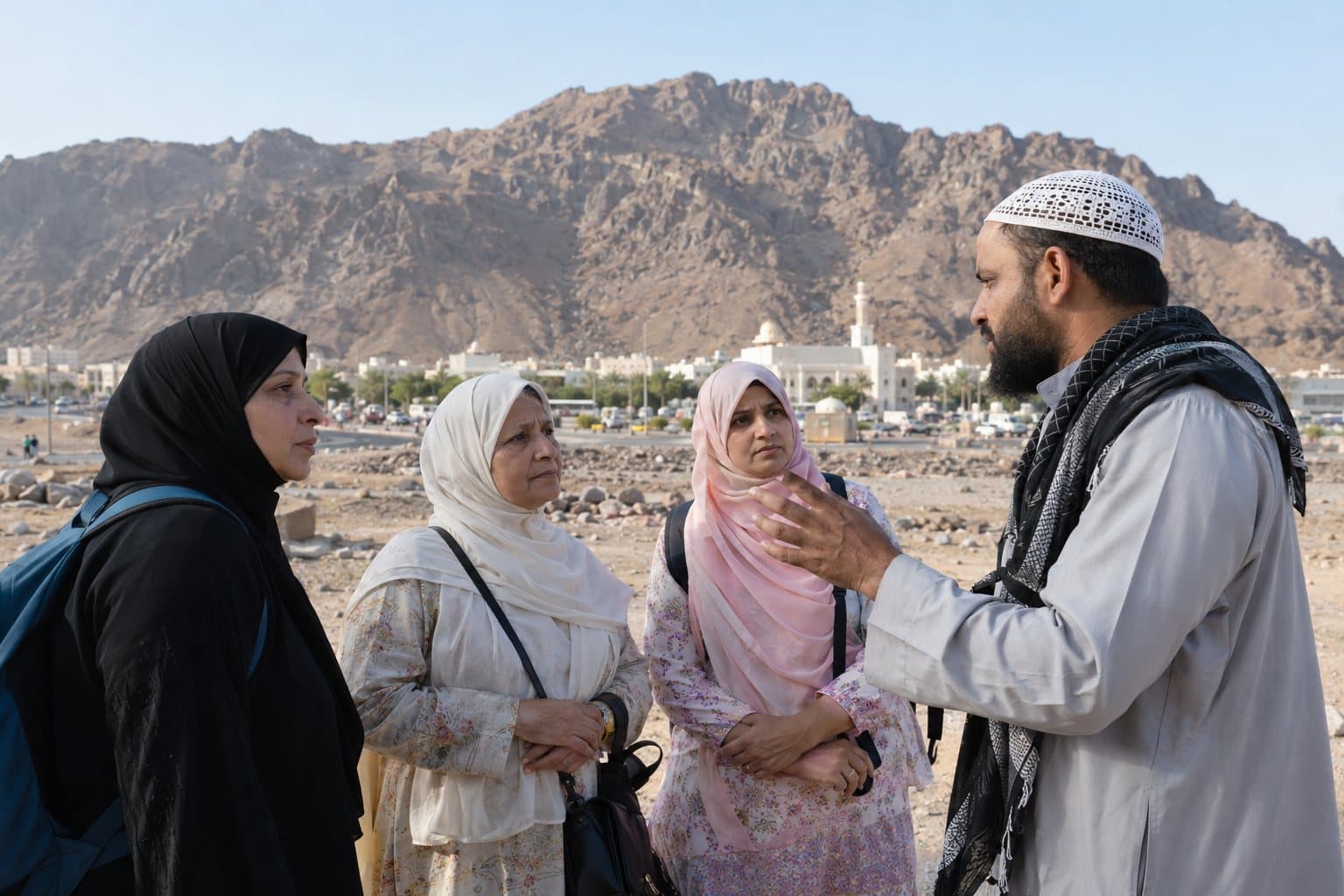
A ziyarat day is easier when you know what each stop involves. Ziyarat usually takes a few hours in each city, so plan your rest and prayers around it.
- From the coach or a short stop: Arafat, Muzdalifah, Mina and Jabal Thawr
- A short walk from the coach: Masjid Quba, Masjid al-Qiblatain, the Uhud graveyard and the Seven Mosques
- A real climb: the Cave of Hira on Jabal al-Nour and the cave on Jabal Thawr; for fit adults only, early in the morning, and not part of a normal group visit
- Heat: go in the morning and be back before midday; even in the cooler months, the sun is strong
- Elders: they can stay seated in the coach at stops that involve a climb or a long walk
Tick items as you go; they are saved on this device.
Good manners at the places you visit
These places are part of our history, and how we visit them matters. Keep it simple: learn the story, make du’a for yourself, your family and the ummah, and follow the signs and the guards.
- Don’t write names on rocks or walls, and don’t take stones or soil as keepsakes
- Don’t push, and don’t climb the railings at graveyards and mosques
- Dress modestly and keep your voice low, especially at the graveyards
- Stay with your group and be back at the coach on time
- If you are unsure what is right to do at a place, ask a qualified scholar rather than copying the crowd
Questions
Most groups see Jabal al-Nour (the Cave of Hira), Jabal Thawr, Arafat with Jabal al-Rahmah, Muzdalifah and Mina, usually in one morning by coach. Masjid Aisha at Tan’eem is visited by those who go for another Umrah.
Related on our site
This guide is general travel information. For religious rulings, please ask a qualified scholar.