
On this page
Key points
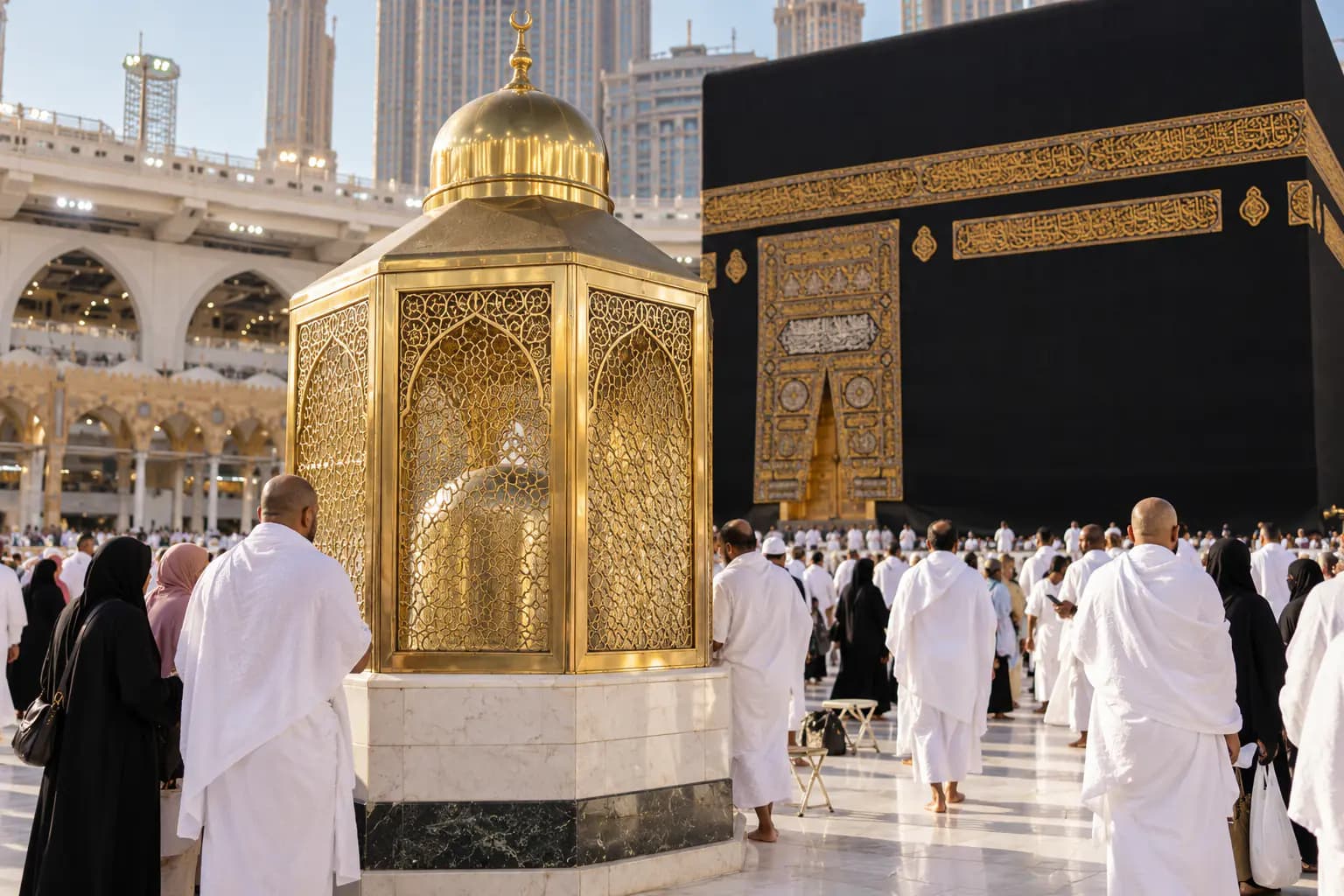
- Maqam Ibrahim is the stone Ibrahim (AS) stood on while building the Kaaba. It is kept in a gold and glass case a few metres from the Kaaba door.
- After tawaf, pray two rak’ahs behind the Maqam if there is space. If it is crowded, pray anywhere in the mosque: that is fine.
- The Hijr Ismail (Hateem) is the low curved wall on the north side of the Kaaba. The area inside it is part of the House.
- Tawaf must go around the outside of the Hijr. Praying inside it is like praying inside the Kaaba.
What Maqam Ibrahim is
Maqam means “standing place”. It is the stone that Ibrahim (AS) stood on while he raised the walls of the Kaaba with his son Ismail (AS). The Qur’an names it among the clear signs in the Sacred House (3:97).
Today the stone is kept inside a gold-coloured frame with glass, on a marble base, facing the door of the Kaaba. Looking through the glass, many people can see the shape of footprints pressed into the stone.
The two rak’ahs after tawaf
When the Prophet ﷺ finished his tawaf, he went to the Maqam, recited the verse below, and prayed two rak’ahs with the Maqam between him and the Kaaba (Muslim 1218). In them he recited Surah al-Kafirun and Surah al-Ikhlas.
Going to the Maqam after tawaf
وَاتَّخِذُوا مِنْ مَقَامِ إِبْرَاهِيمَ مُصَلًّى
Wattakhidhu min maqami Ibrahima musalla.
And take the standing place of Ibrahim as a place of prayer.
Qur’an 2:125
Praying right behind the Maqam is best only when it is easy. In the crowd, step back, or pray anywhere in the mosque. Never pray in the path of people doing tawaf.
What the Hijr Ismail (Hateem) is
On the north side of the Kaaba, under the golden rain spout, there is a low curved wall. The space inside it is called the Hijr Ismail, and in South Asia it is usually called the Hateem.
Aisha (RA) asked the Prophet ﷺ whether this area was part of the Kaaba, and he said yes. The Quraysh left it out when they rebuilt the House because they did not have enough lawful money to finish it (Bukhari 1584).
Tawaf goes outside the Hijr
Because the Hijr is part of the House, your tawaf must go around the outside of its curved wall. If you walk through the Hijr during tawaf, that round does not count, since you have not gone around the whole Kaaba.
This is easy to miss when the crowd pushes you towards the wall, so keep the Hijr on your left with the Kaaba.
Praying inside the Hijr
Aisha (RA) wished to pray inside the Kaaba. The Prophet ﷺ took her into the Hijr and told her to pray there, because it is part of the House (Abu Dawud 2028). So any pilgrim who prays in the Hijr is praying inside the Kaaba.
- Entry is sometimes closed for crowd control, so check with the guards
- Late night and the time after Fajr are usually calmer
- Pray two rak’ahs of nafl, make your du’a, and make space for the next person
- Women often have separate times or a calmer side; ask the female staff at the Haram
Questions
The stone Ibrahim (AS) stood on while building the Kaaba. It is kept in a gold and glass case near the Kaaba door, and the Qur’an calls it one of the clear signs of the House (3:97).
Related on our site
Official guidance
- Qur’an 2:125: take the Maqam of Ibrahim as a place of prayer
- Qur’an 3:97: clear signs, the Maqam of Ibrahim
- Sahih Muslim 1218: the Prophet ﷺ praying two rak’ahs at the Maqam after tawaf
- Sahih al-Bukhari 1584: the curved wall is part of the Kaaba
- Sunan Abi Dawud 2028: pray in the Hijr, for it is part of the House
This guide is general travel information. For religious rulings, please ask a qualified scholar.