
On this page
Key points
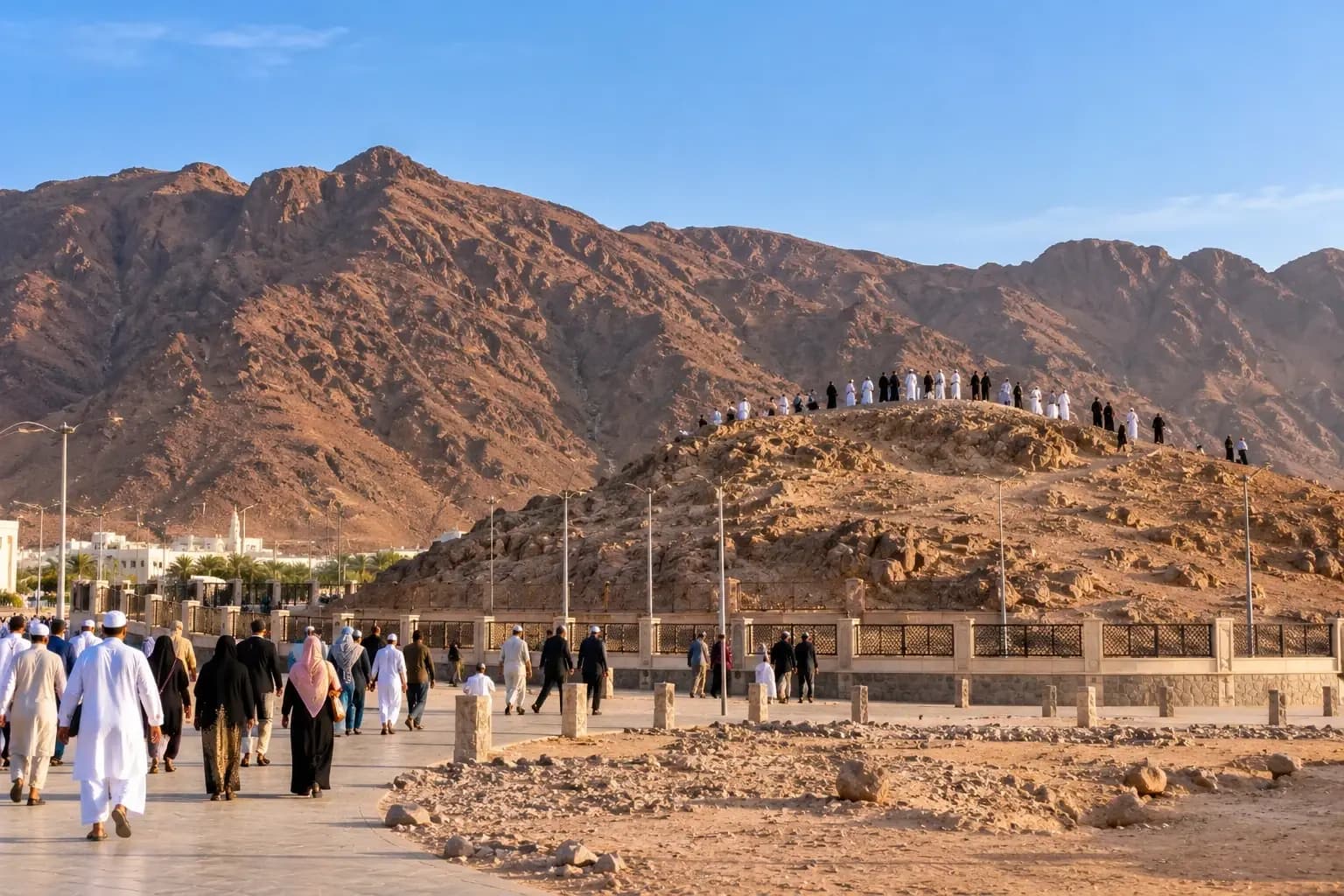
- Uhud is the large red mountain on the north side of Madinah, about 5 km from Masjid an-Nabawi.
- The Battle of Uhud was fought at its foot in the third year after the Hijrah. About seventy Muslims were martyred, among them Hamzah (RA), the Prophet’s ﷺ uncle.
- The small hill in front of it is Jabal al-Rumah, the archers’ hill, where the Prophet ﷺ placed fifty archers and told them not to leave.
- The Prophet ﷺ said of Uhud: “This is a mountain that loves us and we love it” (Bukhari 4083).
A mountain that loves us
Uhud is the long, reddish mountain that stands on the north side of Madinah. You can see it from many parts of the city. The Prophet ﷺ spoke of it with love: “This is a mountain that loves us and we love it” (Bukhari 4083).
For pilgrims, Uhud is a place of remembrance. At its foot lie the martyrs of one of the hardest days in the life of the Prophet ﷺ and his companions.
The Battle of Uhud
In the third year after the Hijrah, the Quraysh of Makkah came to Madinah with a large army. The Muslims, far fewer in number, came out to meet them at the foot of Uhud.
The Prophet ﷺ placed fifty archers on a small hill under Abdullah ibn Jubayr (RA) and told them clearly not to leave their place, whatever they saw, until he sent for them (Bukhari 3039). The Muslims were winning at first. Then most of the archers, thinking the battle was over, came down. The enemy horsemen went around the hill and attacked from behind, and the day turned.
Many companions were martyred, and the Prophet ﷺ himself was wounded. The Qur’an speaks of that day in Surah Aal-Imran: Allah had kept His promise, until some disobeyed the order (3:152). Pilgrims remember the lesson of obedience and patience, and the mercy that followed.
Hamzah (RA) and the martyrs
About seventy Muslims were martyred at Uhud. Among them was Hamzah ibn Abd al-Muttalib (RA), the uncle of the Prophet ﷺ, called the Lion of Allah. He was killed by Wahshi with a spear (Bukhari 4072). The Prophet ﷺ grieved deeply for him.
The martyrs were buried where they fell, in a simple graveyard at the foot of the mountain, now inside a low fence. The Qur’an says: “Do not think of those killed in the way of Allah as dead. They are alive with their Lord, receiving provision” (3:169).
At the graves of the martyrs
السَّلَامُ عَلَيْكُمْ أَهْلَ الدِّيَارِ مِنَ الْمُؤْمِنِينَ وَالْمُسْلِمِينَ، وَإِنَّا إِنْ شَاءَ اللَّهُ لَلَاحِقُونَ، أَسْأَلُ اللَّهَ لَنَا وَلَكُمُ الْعَافِيَةَ
Assalamu ‘alaykum ahlad-diyari minal-mu’minina wal-muslimin, wa inna in sha’ Allahu lalahiqun. As’alullaha lana wa lakumul-‘afiyah.
Peace be upon you, people of these dwellings, believers and Muslims. We will, if Allah wills, join you. I ask Allah for well-being for us and for you.
Sahih Muslim 975
What you see on the visit
- The martyrs’ graveyard: a fenced area at the foot of the mountain. Give salam and make du’a from outside the fence
- Jabal al-Rumah, the archers’ hill: the small hill opposite the graveyard. Many visitors climb its steps to look over the battlefield
- Masjid Sayyid al-Shuhada: a large mosque beside the graveyard, where you can pray and use the wudu areas
- Mount Uhud itself: a large, rocky mountain. Climbing it is not part of the visit and can be dangerous in the heat
Tips for the visit
- Go in the morning or late afternoon. The open ground is very hot at midday for most of the year
- Wear comfortable shoes if you plan to climb the archers’ hill; the steps can be steep and sandy
- Elderly parents can stay near the graveyard fence and the mosque, where the ground is flat
- Do not touch the fence, tie threads or take soil. Make du’a for the martyrs and remember their sacrifice
Questions
On the north side of Madinah, about 5 km from Masjid an-Nabawi, around 10 to 15 minutes by car.
Related on our site
Official guidance
- Sahih al-Bukhari 4083: “This is a mountain that loves us and we love it”
- Sahih al-Bukhari 3039: the archers at Uhud and Abdullah ibn Jubayr (RA)
- Sahih al-Bukhari 4072: the martyrdom of Hamzah (RA)
- Qur’an 3:152: Allah’s promise, and what happened when the order was not kept
- Qur’an 3:169–170: do not think of those killed in Allah’s way as dead
- Sahih Muslim 975: the du’a for visiting graves
This guide is general travel information. For religious rulings, please ask a qualified scholar.