
On this page
Key points
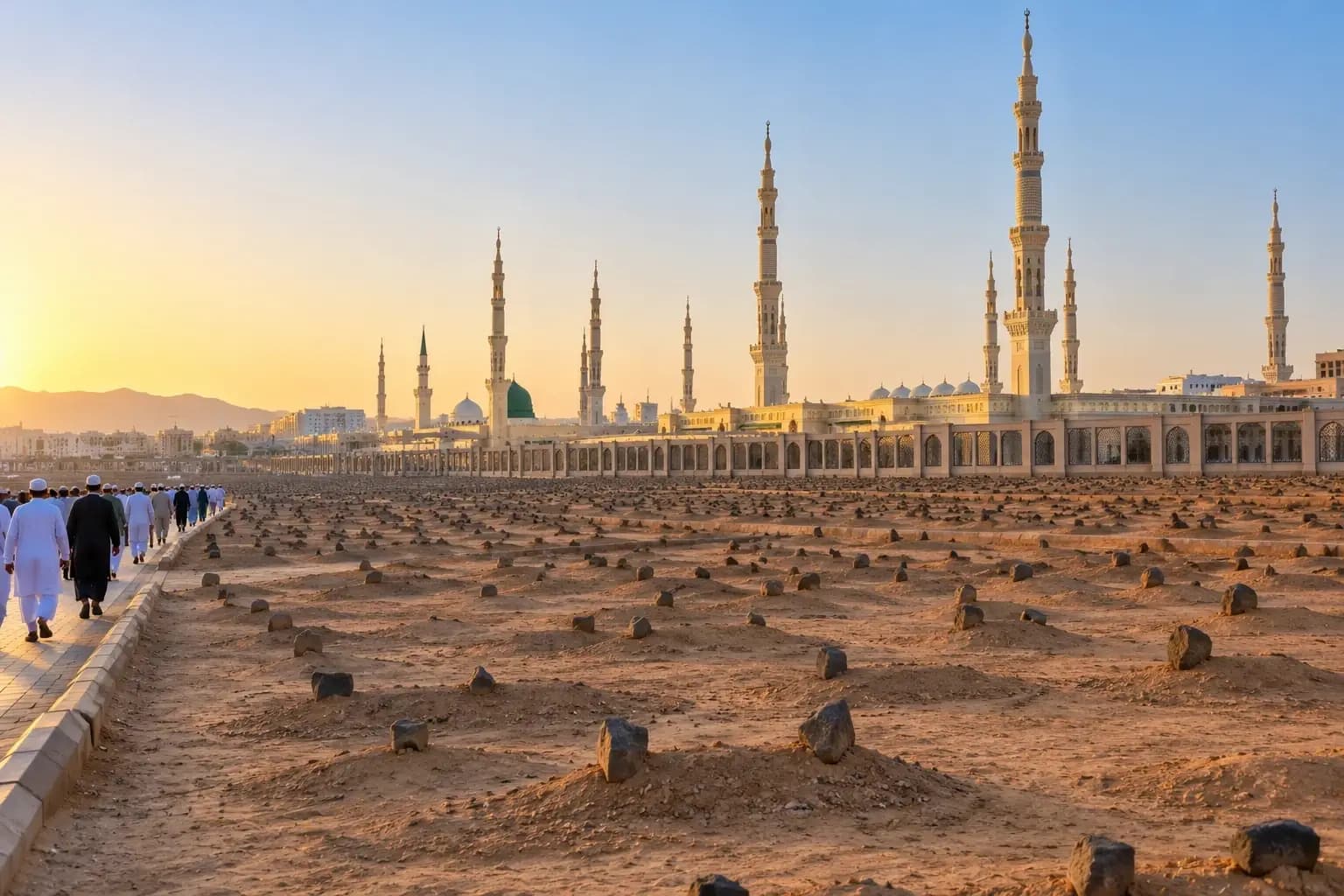
- Jannatul Baqi, or al-Baqi’, is the main graveyard of Madinah, right next to Masjid an-Nabawi on its south-east side.
- Thousands of companions are buried there, along with members of the Prophet’s ﷺ family, including several of his wives and his son Ibrahim.
- The Prophet ﷺ visited al-Baqi’ and prayed for its people. The sunnah is to give salam and make du’a for them.
- Visiting hours are short and set by the authorities, and the rules for women are different from men’s. Check on the day.
What Jannatul Baqi is
Al-Baqi’ is the oldest Muslim graveyard of Madinah. Pilgrims from India often call it Jannatul Baqi. It lies just outside the south-east side of Masjid an-Nabawi, so you can walk there from the courtyard in a few minutes.
Inside, the graves are simple and low, marked with small stones, with paths between them. There are no domes or decorated tombs, and most graves have no names.
Who is buried there
- Uthman ibn Affan (RA), the third caliph
- Many of the wives of the Prophet ﷺ, the Mothers of the Believers, among them Aisha (RA)
- Ibrahim, the infant son of the Prophet ﷺ
- Hasan ibn Ali (RA), the grandson of the Prophet ﷺ, and al-Abbas (RA), his uncle
- Thousands of companions, and many scholars and pilgrims who passed away in Madinah over the centuries
Exact places of individual graves are known only in some cases. Guides may point to areas; there is no need to search for a particular grave.
The du’a for visiting graves
When you reach the graveyard, give salam to its people with the words the Prophet ﷺ taught, then make du’a for them and for yourself.
Entering the graveyard
السَّلَامُ عَلَيْكُمْ أَهْلَ الدِّيَارِ مِنَ الْمُؤْمِنِينَ وَالْمُسْلِمِينَ، وَإِنَّا إِنْ شَاءَ اللَّهُ لَلَاحِقُونَ، أَسْأَلُ اللَّهَ لَنَا وَلَكُمُ الْعَافِيَةَ
Assalamu ‘alaykum ahlad-diyari minal-mu’minina wal-muslimin, wa inna in sha’ Allahu lalahiqun. As’alullaha lana wa lakumul-‘afiyah.
Peace be upon you, people of these dwellings, believers and Muslims. We will, if Allah wills, join you. I ask Allah for well-being for us and for you.
Sahih Muslim 975
The Prophet’s ﷺ du’a for the people of al-Baqi’
اللَّهُمَّ اغْفِرْ لِأَهْلِ بَقِيعِ الْغَرْقَدِ
Allahummaghfir li ahli Baqi‘il-Gharqad.
O Allah, forgive the people of Baqi’ al-Gharqad.
Sahih Muslim 974
Visiting times and women
The gate is usually opened for a short time after Fajr and after Asr. Times are set by the authorities and can change, especially in Ramzan and the Hajj season, so check at the gate or with your group on the day.
In recent years women have not been allowed inside the graveyard; they can make du’a from outside the wall. These rules can change too, so follow what the staff say on the day.
Simple etiquette
- Walk on the paths and do not step or sit on graves
- Keep your voice low and remember that you too will return to Allah
- Make du’a for the dead facing the qiblah; do not touch graves, take soil or stones, or do anything the sunnah did not teach
- Follow the instructions of the guards and the time they give; they close the gate on time
Questions
Right beside Masjid an-Nabawi in Madinah, on its south-east side. It is a few minutes’ walk from the mosque courtyard.
Related on our site
Official guidance
This guide is general travel information. For religious rulings, please ask a qualified scholar.