
On this page
Key points
- Muzdalifah is the open area between Arafat and Mina where pilgrims spend the night after the Day of Arafah.
- On arrival, pray Maghrib and Isha together, then rest. The Prophet ﷺ slept here until Fajr.
- Most pilgrims collect their pebbles for the Jamarat here, though pebbles may be picked from anywhere.
- The Prophet ﷺ allowed the weak and some women to leave after midnight. Others leave after Fajr, before sunrise.
What Muzdalifah is
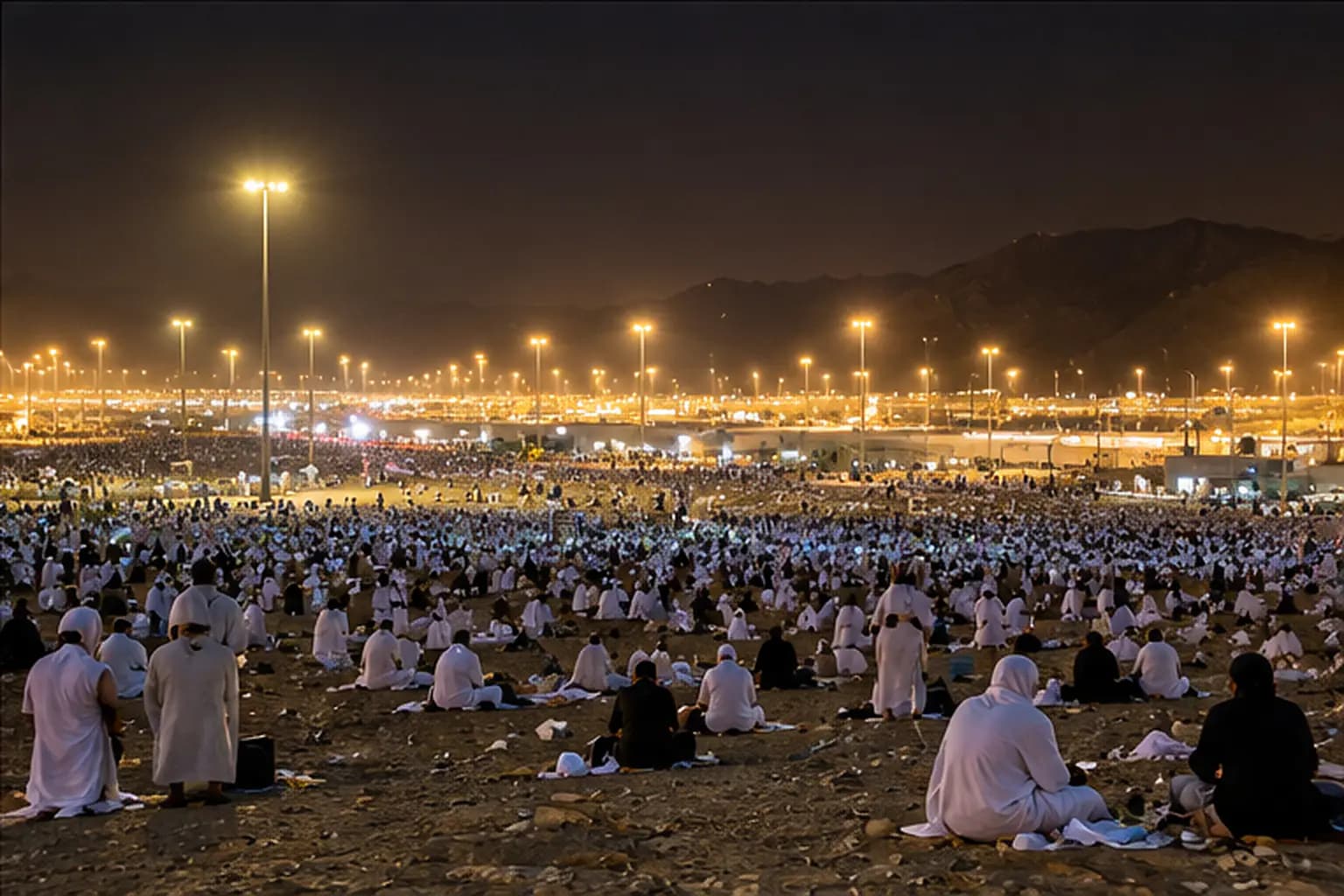
Muzdalifah, also called Jam’, lies between Arafat and Mina, about 9 km from each, depending on the route. There are no tents: pilgrims rest on mats on the ground, under lights, with toilets and water points around the area.
Allah says, “When you leave Arafat, remember Allah at al-Mash’ar al-Haram” (2:198). Al-Mash’ar al-Haram is in Muzdalifah, and a mosque stands there today.
The night, step by step
- 1
Step 1
Arrive after sunset
Leave Arafat only after sunset. Buses and walkways are slow that night, and many groups reach Muzdalifah late.
- 2
Step 2
Pray Maghrib and Isha together
As soon as you arrive, pray Maghrib and then Isha (shortened to two), together, as the Prophet ﷺ did (Bukhari 1675).
- 3
Step 3
Rest
The Prophet ﷺ lay down and slept until dawn (Muslim 1218). Sleep if you can. Tomorrow is the busiest day of Hajj.
- 4
Step 4
Fajr and du’a
Pray Fajr early, then face the qiblah and make du’a and dhikr until the sky is bright.
- 5
Step 5
Leave for Mina
Leave for Mina before sunrise, ready for the stoning of Jamrat al-Aqabah.
Collecting the pebbles
- Pebbles should be small, about the size of a chickpea or a date stone, not rocks
- You need 7 for the 10th, and 21 for each of the 11th, 12th and (if you stay) the 13th: 49 or 70 in all. Many pilgrims take a few extra
- They do not have to come from Muzdalifah. It is simply the easiest place to pick them; pebbles from Mina are fine too
- There is no need to wash them. Keep them in a small cloth bag or bottle in your pocket
The allowance for the weak
Sauda (RA), a slow and heavy woman, asked the Prophet ﷺ to let her leave Muzdalifah before the crowds, and he allowed her (Bukhari 1681). Abdullah ibn Umar (RA) used to send the weak of his family ahead at night as well (Bukhari 1676).
So the elderly, the sick, women with them and those who look after them may leave after the middle of the night (after the moon sets, in some narrations). Many Indian groups use this for elderly pilgrims. Ask your group’s scholar how your group follows it.
The schools differ on how long the stay at Muzdalifah must be and what happens if it is missed. Your group’s scholar will explain the ruling you follow.
Practical tips
- Carry a thin mat or sheet, a small pillow or rolled cloth, and a light blanket: nights can be warm, but the ground is hard
- Keep water, dates and your medicines with you; the area is crowded and shops are few
- Stay close to your group’s marked spot. Note the nearest light pole number or sign
- Use the toilets early in the night, before the queues grow
Questions
Between Arafat and Mina, east of Makkah. Pilgrims pass through it on the way back from Arafat to Mina.
Related on our site
Official guidance
- Qur’an 2:198: remember Allah at al-Mash’ar al-Haram
- Sahih Muslim 1218: the night at Muzdalifah and leaving before sunrise
- Sahih al-Bukhari 1675: Maghrib and Isha joined at Muzdalifah
- Sahih al-Bukhari 1681: Sauda (RA) given permission to leave early
- Sahih al-Bukhari 1676: Ibn Umar sending the weak of his family ahead
- Jami at-Tirmidhi 889: whoever reaches Jam (Muzdalifah) before Fajr
This guide is general travel information. For religious rulings, please ask a qualified scholar.