
On this page
Key points
- Indian pilgrims usually perform Hajj al-Tamattu’: Umrah first, then Hajj in a fresh ihram.
- Standing at Arafat on the 9th of Dhul Hijjah is the heart of Hajj.
- On the 10th: stoning at Jamarat al-Aqabah, qurbani, shaving or trimming, then tawaf al-ifadah and sa’i.
- From the 11th to the 13th, pilgrims stone the three jamarat with seven pebbles each.
- Rulings differ between schools, so learn the details from a qualified scholar and follow your group’s guidance.
The three types of Hajj
There are three ways to perform Hajj. Your scholar and group will tell you which one to make the intention for.
- Tamattu’: Umrah first, in the months of Hajj, then leaving ihram, and entering ihram again for Hajj on the 8th. A sacrifice is required. Indian pilgrims usually perform this type.
- Qiran: Umrah and Hajj together in one ihram, without leaving it in between. A sacrifice is required.
- Ifrad: Hajj only, in one ihram. A sacrifice is not required, though it may be offered.
Day by day: 8 to 13 Dhul Hijjah
- 1
Step 1
8th Dhul Hijjah: to Mina
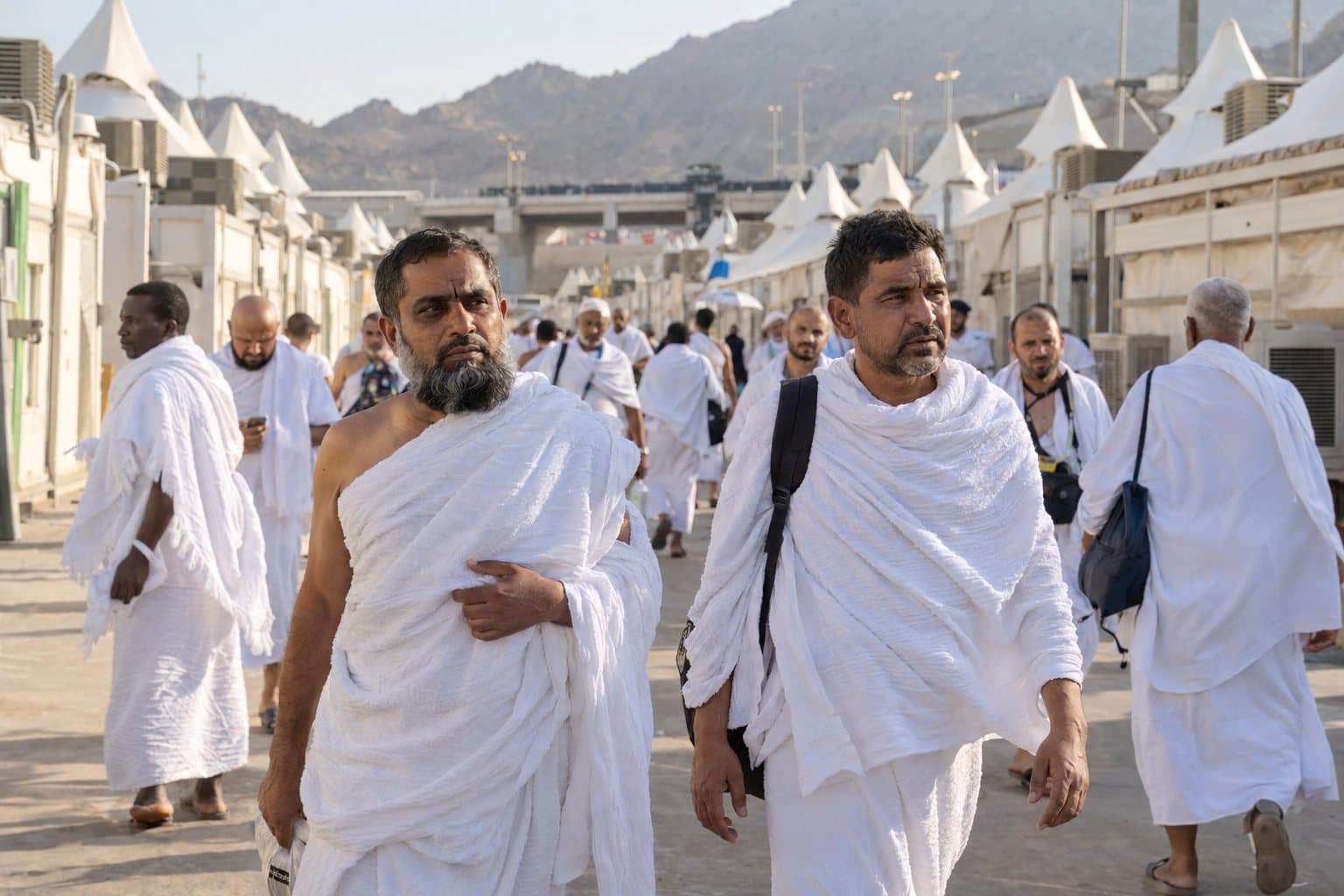
Pilgrims performing Tamattu’ enter ihram again from where they are staying in Makkah, make the intention for Hajj and begin the talbiyah. Groups move to the tents of Mina and pray Dhuhr, Asr, Maghrib, Isha and the next Fajr there. It is a day of rest, prayer and preparation.
- 2
Step 2
9th Dhul Hijjah: the Day of Arafah
After sunrise, pilgrims travel to Arafat. Being at Arafat on this day (wuquf) is the most important pillar of Hajj. Dhuhr and Asr are prayed, and the rest of the day is spent in du’a, dhikr and Qur’an until sunset. Stay within the boundaries of Arafat; your group will show you where they are.
- 3
Step 3
The night after Arafah: Muzdalifah
After sunset, pilgrims leave Arafat for Muzdalifah. Maghrib and Isha are prayed together there, and the night is spent under the open sky. Many pilgrims collect their small pebbles for the stoning here.
- 4
Step 4
10th Dhul Hijjah: the day of Eid
After Fajr at Muzdalifah, pilgrims return to Mina. This is the busiest day of Hajj, with four acts explained in the next section.
- 5
Step 5
11th and 12th: days in Mina
Pilgrims spend these days and nights in Mina and stone all three jamarat each day. After the stoning on the 12th, pilgrims may leave Mina before sunset.
- 6
Step 6
13th: for those who stay
Pilgrims who are still in Mina for the night of the 13th stone the three jamarat again that day, then leave. Your group will tell you its plan.
Some groups leave Mina on the 12th and others stay until the 13th. Both are allowed.
The 10th of Dhul Hijjah in detail
- 1
Step 1
Stoning at Jamarat al-Aqabah
Throw seven pebbles, one at a time, at the large pillar (Jamarat al-Aqabah), saying “Allahu Akbar” with each one. The talbiyah stops when this stoning begins.
- 2
Step 2
Qurbani (the sacrifice)
Pilgrims performing Tamattu’ or Qiran offer a sacrifice. Today this is usually arranged through an approved system, and you are told when it has been done.
- 3
Step 3
Halq or taqsir
Men shave the head (halq) or trim the hair (taqsir); women cut about a fingertip’s length. After this, most ihram restrictions are lifted, except marital relations, and pilgrims can change into normal clothes.
- 4
Step 4
Tawaf al-ifadah and sa’i
Pilgrims go to Masjid al-Haram for tawaf al-ifadah, a pillar of Hajj, and then sa’i. Your scholar will explain whether you need sa’i for your type of Hajj, and the time within which these must be done. After them, all ihram restrictions end.
The order above is the usual one. Schools differ on how strictly the order must be kept, so follow your scholar’s guidance.
Stoning on the 11th, 12th and 13th
- Stone all three jamarat each day, in order: the small one (al-Ula), the middle one (al-Wusta), then the large one (al-Aqabah)
- Seven pebbles at each pillar, one at a time, saying “Allahu Akbar” with each
- You need 49 pebbles in all if you leave on the 12th, or 70 if you stay until the 13th; keep a few spares
- Stoning on these days is usually done after midday; your group will give you times that avoid the worst crowds
- Many pilgrims stop to make du’a after the first and second jamarat
- The sick, the elderly and others who cannot go may appoint someone to stone for them; ask your scholar how this works
Tawaf al-wida (the farewell tawaf)
Before leaving Makkah for the last time, pilgrims perform a farewell tawaf, so that their last act in Makkah is at the House of Allah. Your group will plan it close to your departure.
Women who are menstruating at that time are excused from the farewell tawaf. Ask your scholar about any other situation.
Madinah: before or after Hajj
Visiting Madinah is not part of Hajj, but almost every pilgrim longs to pray in Masjid an-Nabawi and send salam to the Prophet (peace be upon him).
Depending on the flight schedule, your group may visit Madinah before the days of Hajj or after them. Your group will share the plan for your departure.
Staying safe in the days of Hajj
- Drink water often, and use an umbrella in the sun
- Keep your group ID card or wristband and your tent details with you at all times
- Know your tent number in Mina and your group’s meeting point
- Rest whenever you can; the 9th and 10th are long days
- Follow your group leader’s timings for travel and stoning, and never stop or sit down in a moving crowd
This guide is a simple outline. Rulings differ between the schools of thought, so please learn the rites of Hajj from a qualified scholar before you travel.
Questions
Indian pilgrims usually perform Tamattu’: they do Umrah on arrival, leave ihram, and enter ihram again for Hajj on the 8th of Dhul Hijjah. Your scholar will confirm the right intention for you.
Related on our site
This guide is general travel information. For religious rulings, please ask a qualified scholar.